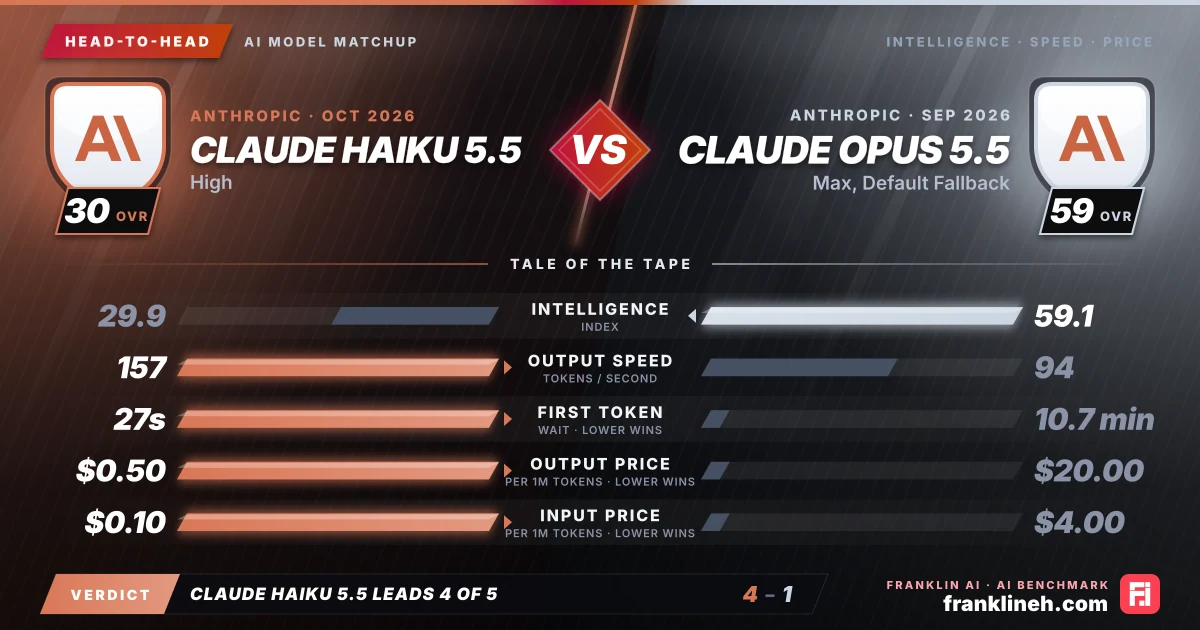
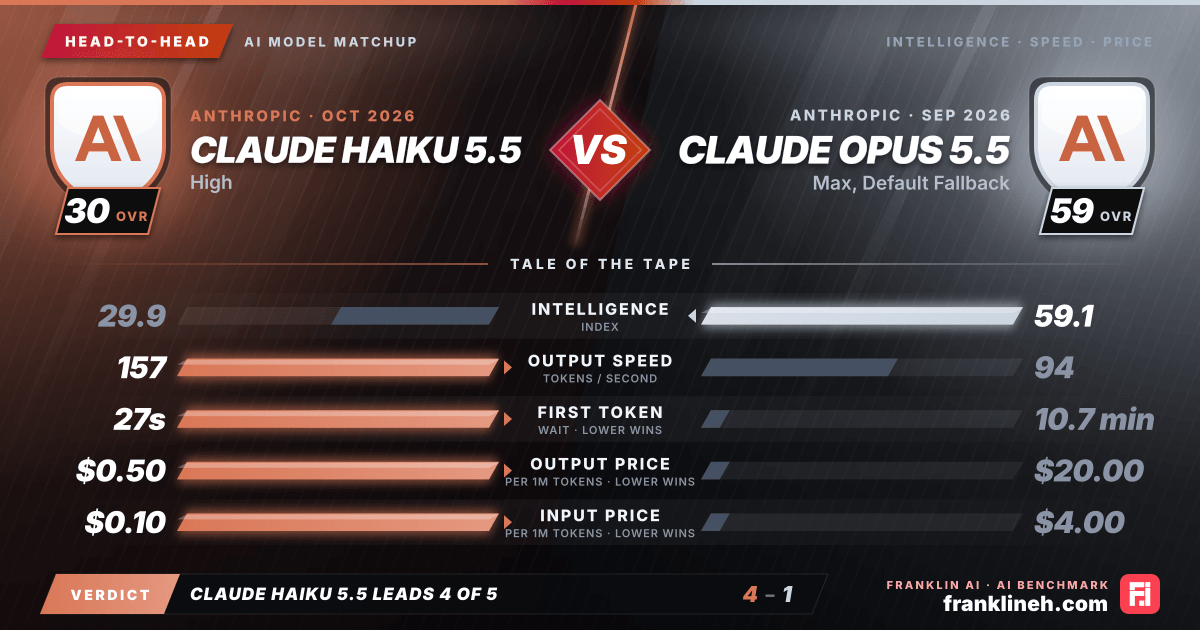
Claude Haiku 5.5 vs Claude Opus 5.5: head-to-head AI benchmark comparison. Claude Haiku 5.5 leads on output speed, time to first token, output price and input price; Claude Opus 5.5 leads on intelligence index.
Claude Haiku 5.5 (High) vs Claude Opus 5.5 (Max, Default Fallback)
Claude Haiku 5.5 (High) vs Claude Opus 5.5 (Max, Default Fallback): Haiku High lowers token rates; Opus Max leads the recorded intelligence index.
Pick it for Claude Haiku 5.5 · High
A budget-sensitive evaluation where the lower recorded input and output rates matter, with a defined quality threshold.
Pick it for Claude Opus 5.5 · Max, Default Fallback
An evaluation that prioritizes the stronger recorded aggregate intelligence result, with task-specific correctness checked separately.
By the numbers
These figures describe the two model configurations shown here. A dash means the source snapshot had no usable figure for that metric. Scores, speed and API pricing may change as providers update models.
Claude Haiku 5.5 (High) and Claude Opus 5.5 (Max, Default Fallback) are compared using Franklin’s captured benchmark records, reviewed on November 6, 2026.
What do the recorded results and rates show?
Claude Haiku 5.5 High records 29.9 on the intelligence index, compared with 59.1 for Claude Opus 5.5 Max with Default Fallback. Haiku lists $0.10 per million input tokens and $0.50 per million output tokens; Opus lists $4 and $20. Those are separate input and output rates. They do not establish a fixed price for a conversation.
How should you use this comparison?
A high-volume classification or extraction workflow can use the rate difference to set a testing budget. A task that needs the stronger recorded aggregate result warrants an Opus evaluation. Check each model on the same documents and acceptance criteria. These records contain no separate coding or math index, so the aggregate score cannot settle either specialist task.
Response speed, latency and release dates
How long do these model variants take to start responding?
The snapshot records time to first token as 26.86 seconds for Claude Haiku 5.5 (High) and 643.93 seconds for Claude Opus 5.5 (Max, Default Fallback). This is a response-start measurement, separate from output speed.
What output speeds are recorded for this pair?
Recorded output speed is 157.3 tokens per second for Claude Haiku 5.5 (High) and 94.22 tokens per second for Claude Opus 5.5 (Max, Default Fallback). An unavailable value remains unmeasured; it is not zero.
Which release dates belong to the compared variants?
The stored release dates are 2026-10-07 for Claude Haiku 5.5 (High) and 2026-09-22 for Claude Opus 5.5 (Max, Default Fallback). The archive page keeps its original publication date; these model facts were reviewed on November 6, 2026.
Final whistle
Test Haiku High where per-token cost matters; test Opus Max where the recorded aggregate-score lead could justify its higher rates.
Where the numbers come from
The scores, speed and prices in this comparison come from independent third-party model evaluations that Franklin AI syncs each day, and the article was written from a snapshot of them. For the latest results, open the Claude Haiku 5.5 (High) and Claude Opus 5.5 (Max, Default Fallback) pages. The AI Benchmark methodology explains how that data is collected and shown.

Comments (0)
to join the discussion
No comments yet
Be the first to share your thoughts!