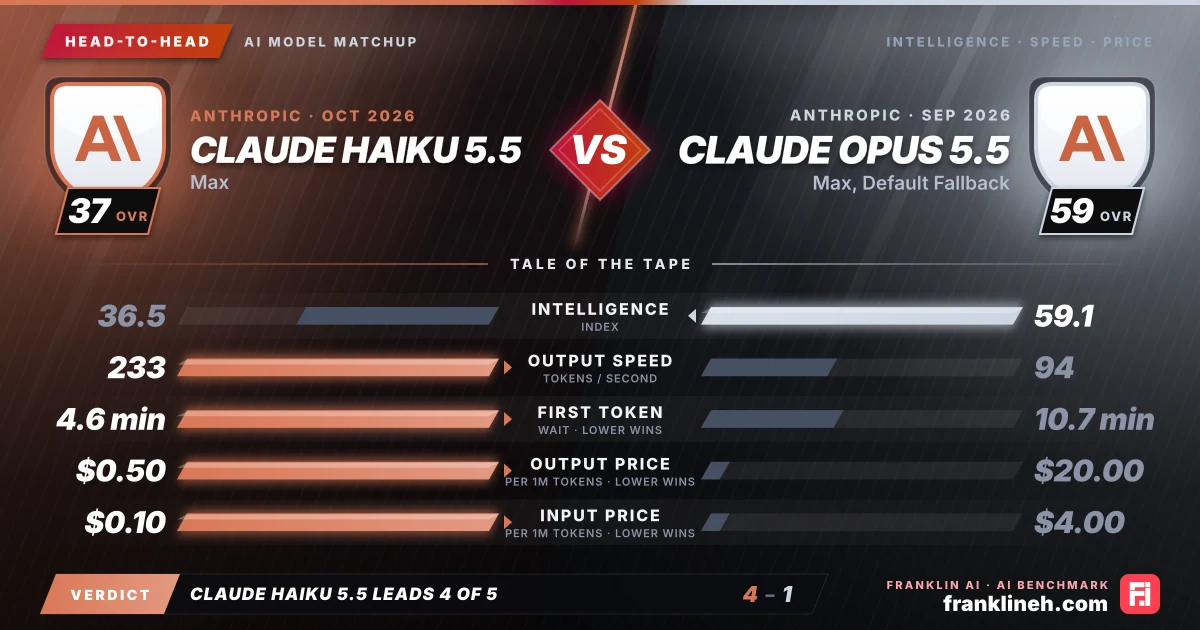
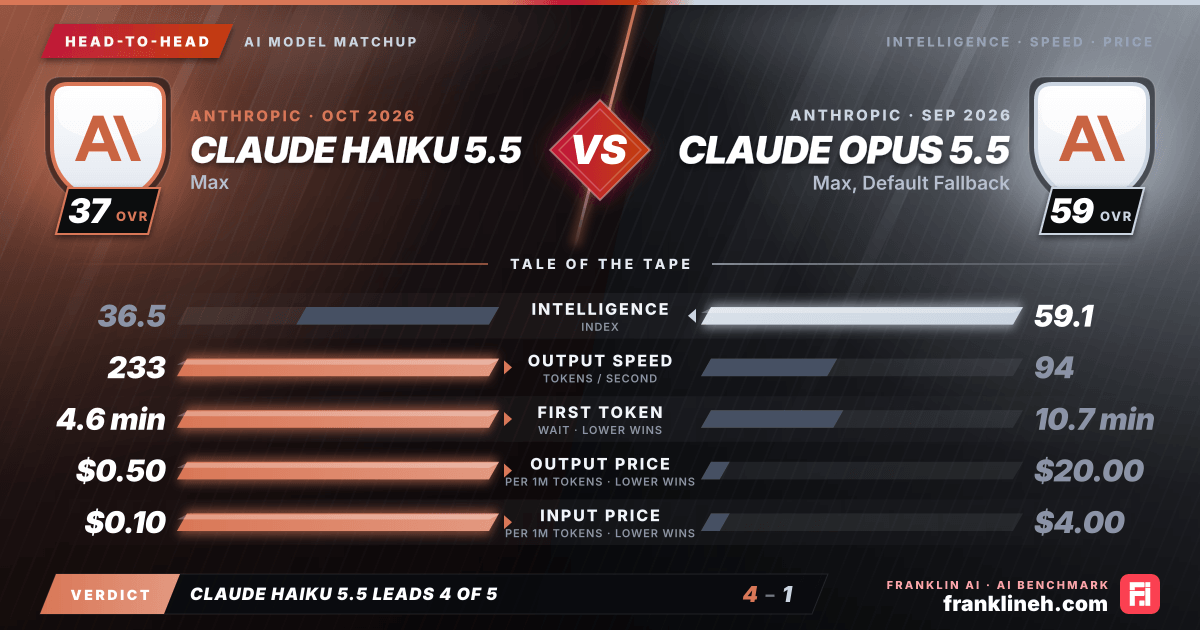
Claude Haiku 5.5 vs Claude Opus 5.5: head-to-head AI benchmark comparison. Claude Haiku 5.5 leads on output speed, time to first token, output price and input price; Claude Opus 5.5 leads on intelligence index.
Claude Haiku 5.5 (Max) vs Claude Opus 5.5 (Max, Default Fallback)
Claude Haiku 5.5 (Max) vs Claude Opus 5.5 (Max, Default Fallback): Opus Max leads the intelligence index; Haiku Max keeps the lower input and output rates.
Pick it for Claude Haiku 5.5 · Max
A budget-sensitive evaluation where the lower recorded input and output rates matter, with a defined quality threshold.
Pick it for Claude Opus 5.5 · Max, Default Fallback
An evaluation that prioritizes the stronger recorded aggregate intelligence result, with task-specific correctness checked separately.
By the numbers
These figures describe the two model configurations shown here. A dash means the source snapshot had no usable figure for that metric. Scores, speed and API pricing may change as providers update models.
Claude Haiku 5.5 (Max) and Claude Opus 5.5 (Max, Default Fallback) are compared using Franklin’s captured benchmark records, reviewed on November 6, 2026.
What do the recorded results and rates show?
Claude Haiku 5.5 Max records 36.5 on the intelligence index, compared with 59.1 for Claude Opus 5.5 Max with Default Fallback. Haiku lists $0.10 per million input tokens and $0.50 per million output tokens. Opus lists $4 and $20. Sharing a Max label does not make the models equivalent in capability, token usage or implementation.
How should you use this comparison?
For a batch-processing budget, calculate input and output charges separately and measure the number of usable results. For a quality-sensitive workflow, test whether Opus improves the cases Haiku misses. There is no separate coding or math index for either model in this snapshot. Keep any decision conditional on your own task evaluation rather than treating the aggregate index as a guarantee.
Response speed, latency and release dates
How long do these model variants take to start responding?
The snapshot records time to first token as 273.17 seconds for Claude Haiku 5.5 (Max) and 643.93 seconds for Claude Opus 5.5 (Max, Default Fallback). This is a response-start measurement, separate from output speed.
What output speeds are recorded for this pair?
Recorded output speed is 232.89 tokens per second for Claude Haiku 5.5 (Max) and 94.22 tokens per second for Claude Opus 5.5 (Max, Default Fallback). An unavailable value remains unmeasured; it is not zero.
Which release dates belong to the compared variants?
The stored release dates are 2026-10-07 for Claude Haiku 5.5 (Max) and 2026-09-22 for Claude Opus 5.5 (Max, Default Fallback). The archive page keeps its original publication date; these model facts were reviewed on November 6, 2026.
Final whistle
Haiku Max has the lower recorded rates; Opus Max has the stronger recorded intelligence result. Compare cost per accepted output in a pilot.
Where the numbers come from
The scores, speed and prices in this comparison come from independent third-party model evaluations that Franklin AI syncs each day, and the article was written from a snapshot of them. For the latest results, open the Claude Haiku 5.5 (Max) and Claude Opus 5.5 (Max, Default Fallback) pages. The AI Benchmark methodology explains how that data is collected and shown.

Comments (0)
to join the discussion
No comments yet
Be the first to share your thoughts!