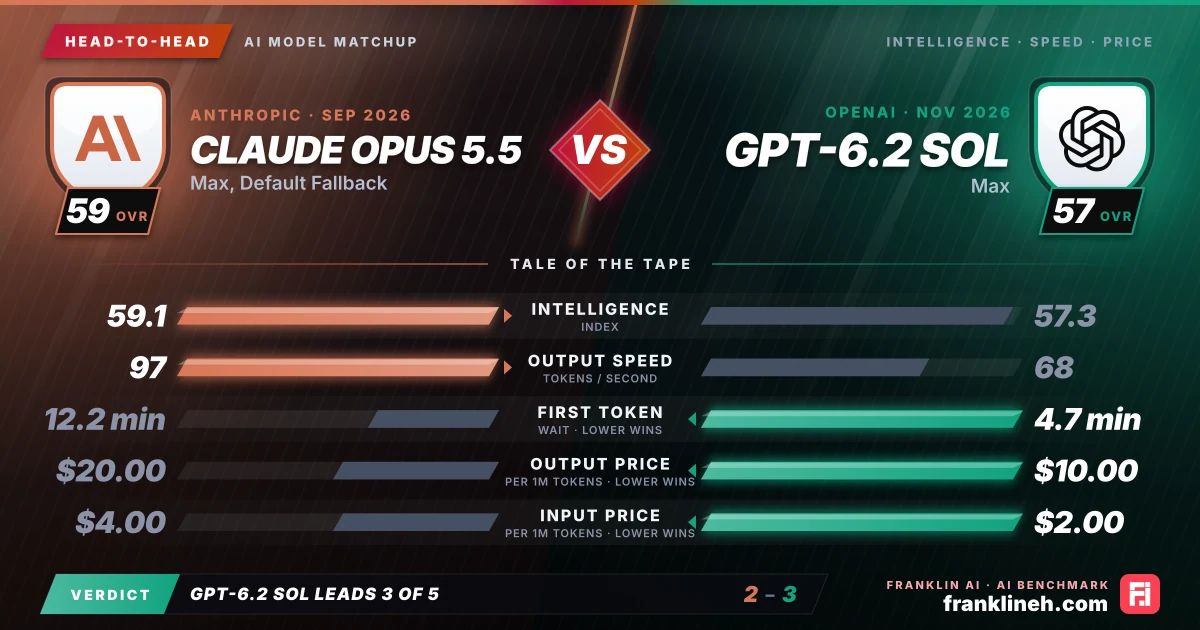
Claude Opus 5.5 vs GPT-6.2 Sol: head-to-head AI benchmark comparison. GPT-6.2 Sol leads on time to first token, output price and input price; Claude Opus 5.5 leads on intelligence index and output speed.
Claude Opus 5.5 (Max, Default Fallback) vs GPT-6.2 Sol (Max)
Claude Opus 5.5 (Max, Default Fallback) vs GPT-6.2 Sol (Max): GPT-6.2 Sol has lower listed input and output token prices. Dedicated task indices are not reported.
Pick it for Claude Opus 5.5 · Max, Default Fallback
Evaluating the 59.1 aggregate-index configuration
Budgeting for listed $4/$20 input/output rates per million tokens
Pick it for GPT-6.2 Sol · Max
Evaluating the 57.3 aggregate-index configuration
Budgeting for listed $2/$10 input/output rates per million tokens
By the numbers
These figures describe the two model configurations shown here. A dash means the source snapshot had no usable figure for that metric. Scores, speed and API pricing may change as providers update models.
Claude Opus 5.5 (Max, Default Fallback) records an intelligence index of 59.1, compared with 57.3 for GPT-6.2 Sol (Max) in the November 26, 2026 snapshot. These are aggregate measurements for the named configurations. Dedicated coding and math indices are not reported for either entry, and the captured benchmark lists are empty. The aggregate index therefore does not establish a coding or mathematics winner.
How do the listed costs compare?
Claude Opus 5.5 lists $4 input and $20 output per million tokens. GPT-6.2 Sol lists $2 input and $10 output per million tokens. Blended cost is not reported. GPT-6.2 Sol has lower listed input and output token rates in this snapshot. That is a cost difference, not evidence of better task quality. Franklin recommends comparing representative requests with the input/output mix and reasoning settings you intend to use. The comparison directory contains the other leading-coverage pairs; inclusion does not measure search popularity.
Claude Opus 5.5 (Max, Default Fallback) vs GPT-6.2 Sol (Max): speed, release dates and providers
What first-token times does the snapshot report?
Claude Opus 5.5 (Max, Default Fallback) reports 729.01 seconds to first token; GPT-6.2 Sol (Max) reports 283.1 seconds. These are the captured configuration measurements, not a latency guarantee for every request.
What output speeds does the snapshot report?
Claude Opus 5.5 (Max, Default Fallback) reports 97.17 tokens per second, while GPT-6.2 Sol (Max) reports 68.04 tokens per second. Output speed and first-token delay describe different parts of the response.
Which release dates are stored for the two entries?
The stored release date is 2026-09-22 for Claude Opus 5.5 (Max, Default Fallback) and 2026-11-17 for GPT-6.2 Sol (Max). These model-entry dates are separate from the comparison’s update date.
Which organizations are associated with these configurations?
Claude Opus 5.5 (Max, Default Fallback) is associated with Anthropic; GPT-6.2 Sol (Max) is associated with OpenAI. The full source labels preserve the reasoning settings and any default-fallback designation.
Final whistle
For Claude Opus 5.5 versus GPT-6.2 Sol: GPT-6.2 Sol has lower listed input and output token rates in this snapshot. That is a cost difference, not evidence of better task quality. Check workload quality, response delay and total token use before choosing.
Where the numbers come from
The scores, speed and prices in this comparison come from independent third-party model evaluations that Franklin AI syncs each day, and the article was written from a snapshot of them. For the latest results, open the Claude Opus 5.5 (Max, Default Fallback) and GPT-6.2 Sol (Max) pages. The AI Benchmark methodology explains how that data is collected and shown.

Comments (0)
to join the discussion
No comments yet
Be the first to share your thoughts!