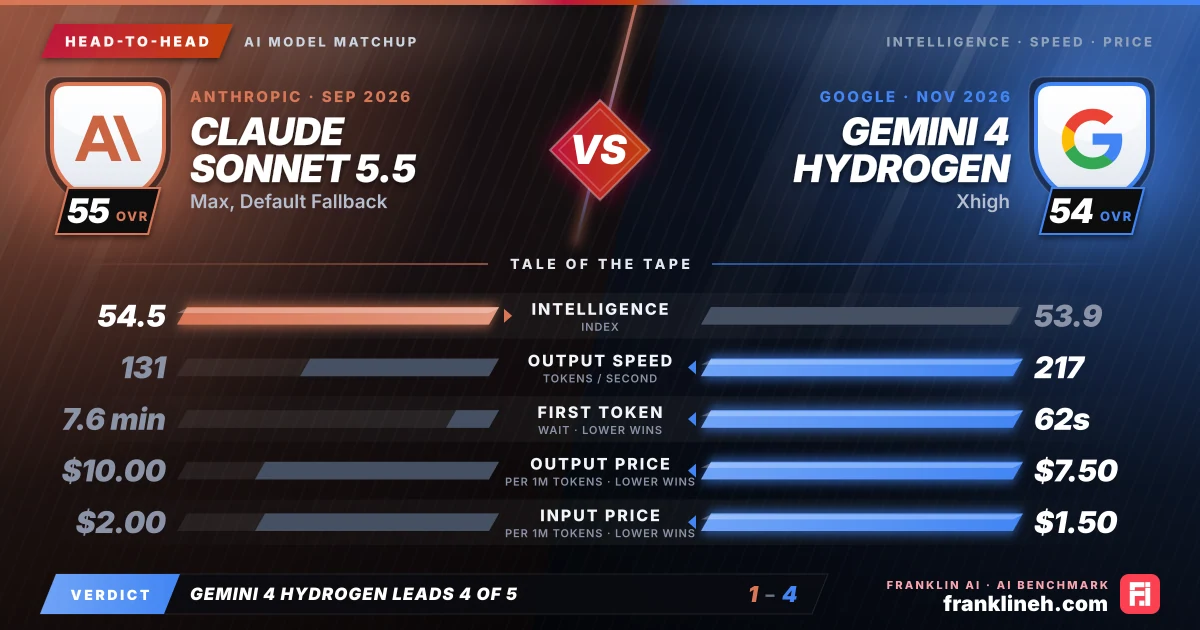
Claude Sonnet 5.5 vs Gemini 4 Hydrogen: head-to-head AI benchmark comparison. Gemini 4 Hydrogen leads on output speed, time to first token, output price and input price; Claude Sonnet 5.5 leads on intelligence index.
Claude Sonnet 5.5 (Max, Default Fallback) vs Gemini 4 Hydrogen (Xhigh)
Claude Sonnet 5.5 (Max, Default Fallback) vs Gemini 4 Hydrogen (Xhigh): Sonnet leads the aggregate index by 0.6; Hydrogen has lower listed rates.
Pick it for Claude Sonnet 5.5 · Max, Default Fallback
Use Sonnet in a matched test of answer quality on the same tasks.
Pick it for Gemini 4 Hydrogen · Xhigh
Use Hydrogen in a trial where you can measure latency and spend.
By the numbers
These figures describe the two model configurations shown here. A dash means the source snapshot had no usable figure for that metric. Scores, speed and API pricing may change as providers update models.
Sonnet’s aggregate index is slightly higher. Hydrogen lists lower rates for both input and output. In the capture Hydrogen reaches its first token earlier and produces tokens at a higher measured rate. Claude Sonnet 5.5 lists $2 input and $10 output, and Gemini 4 Hydrogen lists $1.5 input and $7.5 output per million tokens.
What to measure on your workload
For a comparison, use the same evaluation criteria and record both time to first useful output and time to a finished result. The aggregate score does not predict which variant will handle your particular acceptance criteria.
Timing and benchmark data
How long does each variant take to start responding?
The snapshot records 453.4 seconds for Claude Sonnet 5.5 (Max, Default Fallback) and 62.31 seconds for Gemini 4 Hydrogen (Xhigh).
What is the measured output speed?
The snapshot records 131.21 tokens per second for Claude Sonnet 5.5 (Max, Default Fallback) and 216.77 tokens per second for Gemini 4 Hydrogen (Xhigh).
What release dates does the benchmark record list?
The recorded release dates are 2026-09-28 for Claude Sonnet 5.5 (Max, Default Fallback) and 2026-11-12 for Gemini 4 Hydrogen (Xhigh).
Are separate coding and math indices available?
The captured records do not report a standalone coding or math index for either setting.
Final whistle
Sonnet’s aggregate index is slightly higher. Hydrogen lists lower rates for both input and output. In the capture Hydrogen reaches its first token earlier and produces tokens at a higher measured rate.

Comments (0)
to join the discussion
No comments yet
Be the first to share your thoughts!