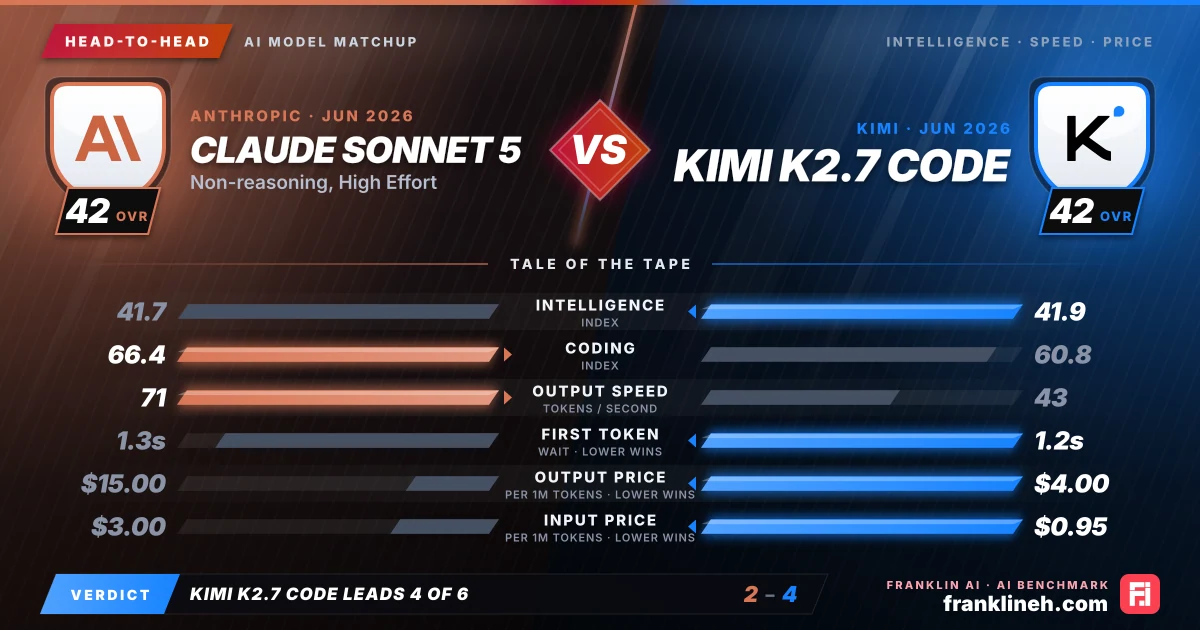
Claude Sonnet 5 vs Kimi K2.7 Code: head-to-head AI benchmark comparison. Kimi K2.7 Code leads on intelligence index, time to first token, output price and input price; Claude Sonnet 5 leads on coding index and output speed.
Claude Sonnet 5 and Kimi K2.7 Code represent specialized advancements in AI. While Sonnet 5 excels in coding metrics, K2.7 Code offers superior cost-efficiency and broader benchmark performance, providing users with distinct choices based on their specific development and budgetary requirements.
Pick it for Claude Sonnet 5 · Non-reasoning, High Effort
High-speed coding tasks
Projects requiring high output throughput
Development workflows favoring Anthropic ecosystems
Pick it for Kimi K2.7 Code
Cost-sensitive production environments
Complex reasoning and research tasks
Applications requiring low time-to-first-token
By the numbers
These figures describe the two model configurations shown here. A dash means the source snapshot had no usable figure for that metric. Scores, speed and API pricing may change as providers update models.
Claude Sonnet 5 (Anthropic) and Kimi K2.7 Code (Kimi) are recent entries in the AI landscape, released in June 2026. Sonnet 5 positions itself as a high-effort coding specialist, while K2.7 Code offers a balance of high benchmark scores and aggressive pricing.
Benchmark Read
Performance metrics reveal a nuanced trade-off between the two models:
Intelligence & Coding: Kimi K2.7 Code holds a slight lead in the Intelligence Index (41.9 vs 41.7), while Claude Sonnet 5 maintains a stronger Coding Index (66.4 vs 60.8).
Benchmarks: Kimi K2.7 Code outperforms Sonnet 5 in GPQA (0.896 vs 0.8), HLE (0.328 vs 0.178), and LCR (0.663 vs 0.587). Sonnet 5 shows a marginal lead in SciCode (0.486 vs 0.475).
Math: Math index data is currently unknown for both models.
Cost and Speed
There is a significant disparity in operational costs. Kimi K2.7 Code is substantially more affordable, with a blended cost of $1.71/1M tokens compared to Claude Sonnet 5’s $6.00/1M.
Regarding speed, Claude Sonnet 5 delivers a faster output speed of 71.116 tok/s compared to Kimi’s 43.074 tok/s. However, Kimi K2.7 Code offers a faster time to first token (1.174s) than Sonnet 5 (1.338s), which may impact perceived latency in interactive applications.
Best Fit
Claude Sonnet 5 is best suited for developers and enterprises prioritizing raw coding throughput and high-speed generation. Kimi K2.7 Code is the optimal choice for users requiring high-level reasoning and broad benchmark performance at a significantly lower price point.
Quick answers
Is Claude Sonnet 5 Non-reasoning better than Kimi K2.7 Code?
Not across the board: they are level on the intelligence index (41.7 and 41.9); Kimi K2.7 Code is 71% cheaper on blended price; and Claude Sonnet 5 Non-reasoning streams output 1.7 times as fast.
Which is faster, Claude Sonnet 5 Non-reasoning or Kimi K2.7 Code?
Claude Sonnet 5 Non-reasoning generates output faster, at 71 tokens per second against 43 tokens per second. Time to first token is similar: 1.3 seconds and 1.2 seconds. Counting the first-token wait, Kimi K2.7 Code finishes short replies first and Claude Sonnet 5 Non-reasoning pulls ahead beyond about 50 tokens.
How much do Claude Sonnet 5 Non-reasoning and Kimi K2.7 Code cost?
Kimi K2.7 Code is cheaper on a blended basis. Claude Sonnet 5 Non-reasoning lists $3.00 per million input tokens and $15.00 per million output tokens; Kimi K2.7 Code lists $0.95 and $4.00. For 1 million input and 200,000 output tokens that is $6.00 against $1.75.
Is Claude Sonnet 5 Non-reasoning or Kimi K2.7 Code better at coding?
Claude Sonnet 5 Non-reasoning has the higher coding index, 66.4 against 60.8.
Who makes Claude Sonnet 5 Non-reasoning and Kimi K2.7 Code?
Claude Sonnet 5 Non-reasoning is made by Anthropic and Kimi K2.7 Code by Kimi. Claude Sonnet 5 Non-reasoning was released on June 30, 2026 and Kimi K2.7 Code on June 12, 2026.
Final whistle
Choose Claude Sonnet 5 if your primary focus is high-performance coding tasks where its superior coding index provides a competitive edge. Opt for Kimi K2.7 Code if you prioritize cost-effectiveness and require a model with stronger performance across a wider range of benchmarks, including GPQA and HLE, making it a more versatile tool for general research and complex logic tasks.
Where the numbers come from
The scores, speed and prices in this comparison come from independent third-party model evaluations that Franklin AI syncs each day, and the article was written from a snapshot of them. For the latest results, open the Claude Sonnet 5 (Non-reasoning, High Effort) and Kimi K2.7 Code pages. The AI Benchmark methodology explains how that data is collected and shown.

Comments (0)
to join the discussion
No comments yet
Be the first to share your thoughts!