Gemini 3.5 Flash and Kimi K2.6 represent competitive mid-tier AI models. While Gemini 3.5 Flash offers higher general intelligence, Kimi K2.6 provides superior coding performance, faster response latency, and significantly lower operational costs for high-volume tasks.
Quick Take
Gemini 3.5 Flash (released May 19, 2026) and Kimi K2.6 (released April 20, 2026) are both mid-tier models designed for efficiency. Gemini 3.5 Flash leads in general intelligence, while Kimi K2.6 excels in coding efficiency and speed.
Benchmark Read
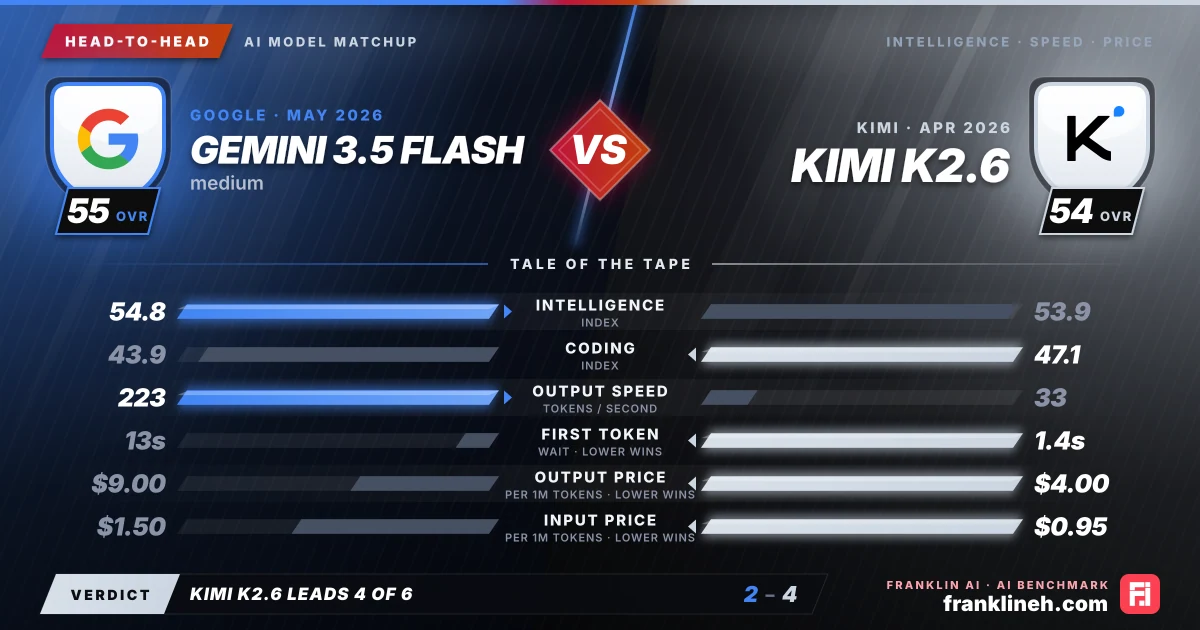
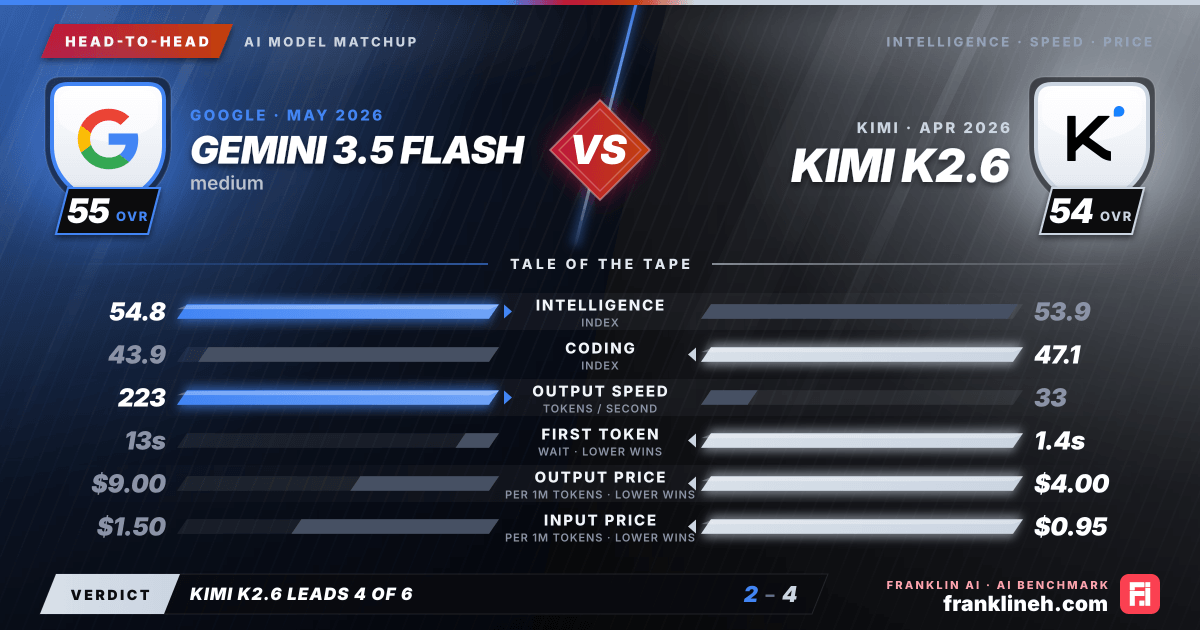
Gemini 3.5 Flash holds an Intelligence index of 54.8, slightly higher than Kimi K2.6’s 53.9. However, Kimi K2.6 demonstrates stronger technical capability with a Coding index of 47.1 compared to Gemini’s 43.9.
In specific benchmarks, the models are closely matched. Gemini 3.5 Flash performs better on GPQA (0.921 vs 0.911) and HLE (0.399 vs 0.359). Conversely, Kimi K2.6 leads in IFBench (0.759 vs 0.745), TerminalBench Hard (0.439 vs 0.393), and TAU2 (0.959 vs 0.956). SciCode results are nearly identical, with Kimi at 0.535 and Gemini at 0.53.
Cost and Speed
Cost is a significant differentiator. Kimi K2.6 is more affordable with a blended price of $1.71/1M tokens, compared to Gemini 3.5 Flash’s $3.38/1M. Kimi also offers a much faster time-to-first-token at 1.416s, whereas Gemini takes 13.209s. However, Gemini 3.5 Flash boasts a higher output speed of 223.093 tok/s, compared to Kimi’s 33.33 tok/s.
Best Fit
Gemini 3.5 Flash is best suited for tasks requiring high-throughput generation where the initial latency is less critical than the final output speed. Kimi K2.6 is the ideal candidate for interactive applications where low latency is required and for coding-heavy workflows where budget efficiency is a priority.
Quick answers
Is Gemini 3.5 Flash medium better than Kimi K2.6?
Not across the board: Gemini 3.5 Flash medium scores higher on the intelligence index, 54.8 to 53.9; Kimi K2.6 is 49% cheaper on blended price; Gemini 3.5 Flash medium streams output 6.7 times as fast; and Kimi K2.6 reaches its first token sooner.
Who makes Gemini 3.5 Flash medium and Kimi K2.6?
Gemini 3.5 Flash medium is made by Google and Kimi K2.6 by Kimi. Gemini 3.5 Flash medium was released on May 19, 2026 and Kimi K2.6 on April 20, 2026.
Which is better for coding, Gemini 3.5 Flash medium or Kimi K2.6?
Kimi K2.6 has the higher coding index, 47.1 against 43.9.
Which is newer, Gemini 3.5 Flash medium or Kimi K2.6?
Gemini 3.5 Flash medium is newer. It was released on May 19, 2026, 29 days after Kimi K2.6 (April 20, 2026).
How much do Gemini 3.5 Flash medium and Kimi K2.6 cost?
Kimi K2.6 is cheaper on a blended basis. Gemini 3.5 Flash medium lists $1.50 per million input tokens and $9.00 per million output tokens; Kimi K2.6 lists $0.95 and $4.00. For 1 million input and 200,000 output tokens that is $3.30 against $1.75.
Final whistle
Choose Gemini 3.5 Flash if your workflow prioritizes general intelligence and complex reasoning tasks. However, for developers and cost-sensitive applications, Kimi K2.6 is the superior choice. Its faster time-to-first-token, higher coding index, and lower blended pricing make it more efficient for real-time interactions and programming assistance, despite Gemini’s slight edge in broad intelligence metrics.

Comments (0)
to join the discussion
No comments yet
Be the first to share your thoughts!