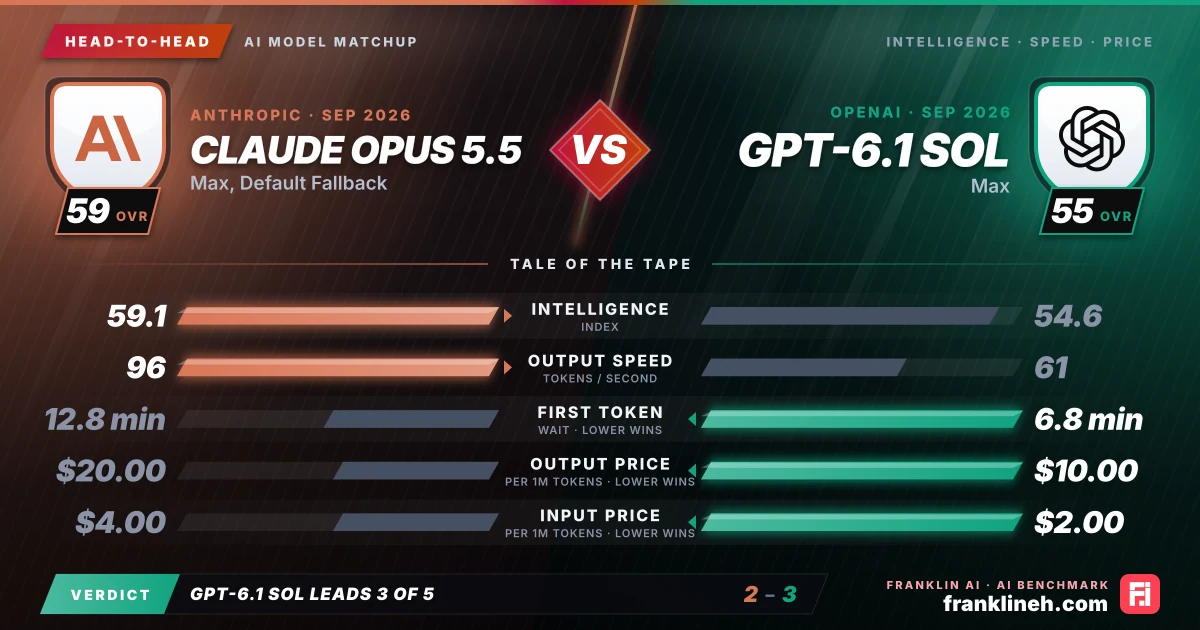
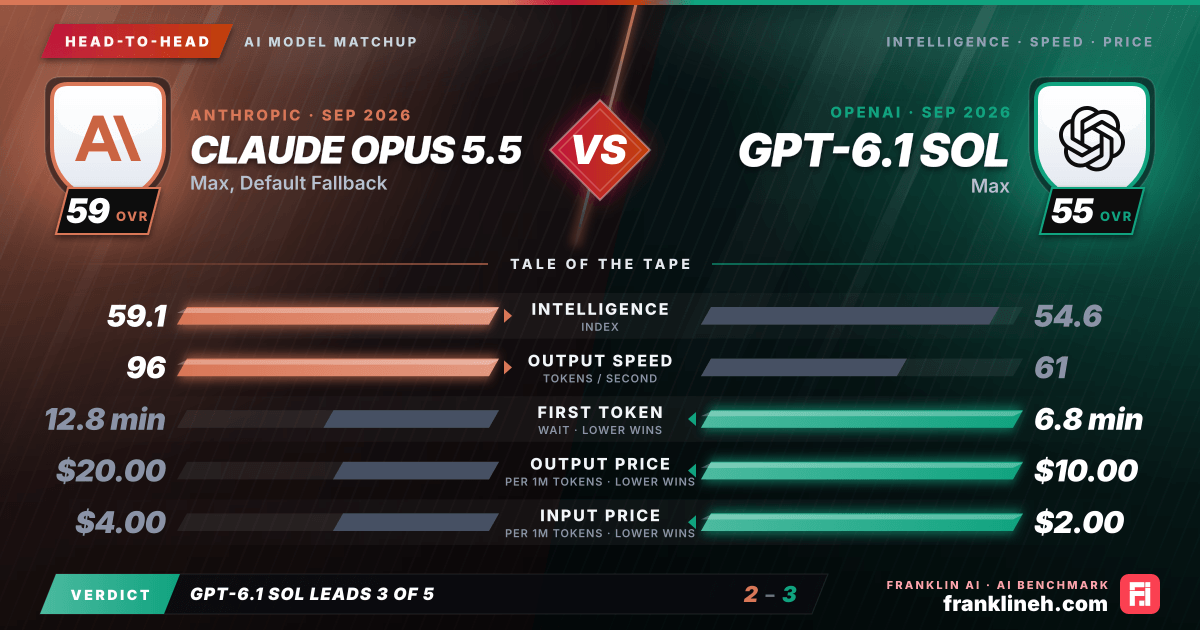
Claude Opus 5.5 vs GPT-6.1 Sol: head-to-head AI benchmark comparison. GPT-6.1 Sol leads on time to first token, output price and input price; Claude Opus 5.5 leads on intelligence index and output speed.
Claude Opus 5.5 (Max, Default Fallback) vs GPT-6.1 Sol (Max) benchmark comparison
Claude Opus 5.5 (Max, Default Fallback) vs GPT-6.1 Sol (Max) scores 59.1 and 54.6 on the captured intelligence index. Compare token rates and response timing.
Pick it for Claude Opus 5.5 · Max, Default Fallback
Measure Opus when output throughput or the aggregate gap matters.
Pick it for GPT-6.1 Sol · Max
Test Sol on interactive work with a clear cost target.
By the numbers
These figures describe the two model configurations shown here. A dash means the source snapshot had no usable figure for that metric. Scores, speed and API pricing may change as providers update models.
Sol’s input and output rates of $2 and $10 per million tokens are half Opus’s. The capture shows Opus emitting faster and Sol reaching its first token sooner.
What to measure on your workload
Measure the length and review effort of accepted answers. With two different response profiles, one workload may care more about how quickly an answer begins and another about how quickly a long answer finishes.
Questions about Claude Opus 5.5 and GPT-6.1 Sol
How long does each variant take to start responding?
The snapshot records 699.57 seconds for Claude Opus 5.5 (Max, Default Fallback) and 276.69 seconds for GPT-6.1 Sol (Max).
What is the measured output speed?
The snapshot records 96.74 tokens per second for Claude Opus 5.5 (Max, Default Fallback) and 66.36 tokens per second for GPT-6.1 Sol (Max).
What release dates does the benchmark record list?
The recorded release dates are 2026-09-22 for Claude Opus 5.5 (Max, Default Fallback) and 2026-09-29 for GPT-6.1 Sol (Max).
Final whistle
Sol’s input and output rates of $2 and $10 per million tokens are half Opus’s. The capture shows Opus emitting faster and Sol reaching its first token sooner.
Where the numbers come from
The scores, speed and prices in this comparison come from independent third-party model evaluations that Franklin AI syncs each day, and the article was written from a snapshot of them. For the latest results, open the Claude Opus 5.5 (Max, Default Fallback) and GPT-6.1 Sol (Max) pages. The AI Benchmark methodology explains how that data is collected and shown.

Comments (0)
to join the discussion
No comments yet
Be the first to share your thoughts!