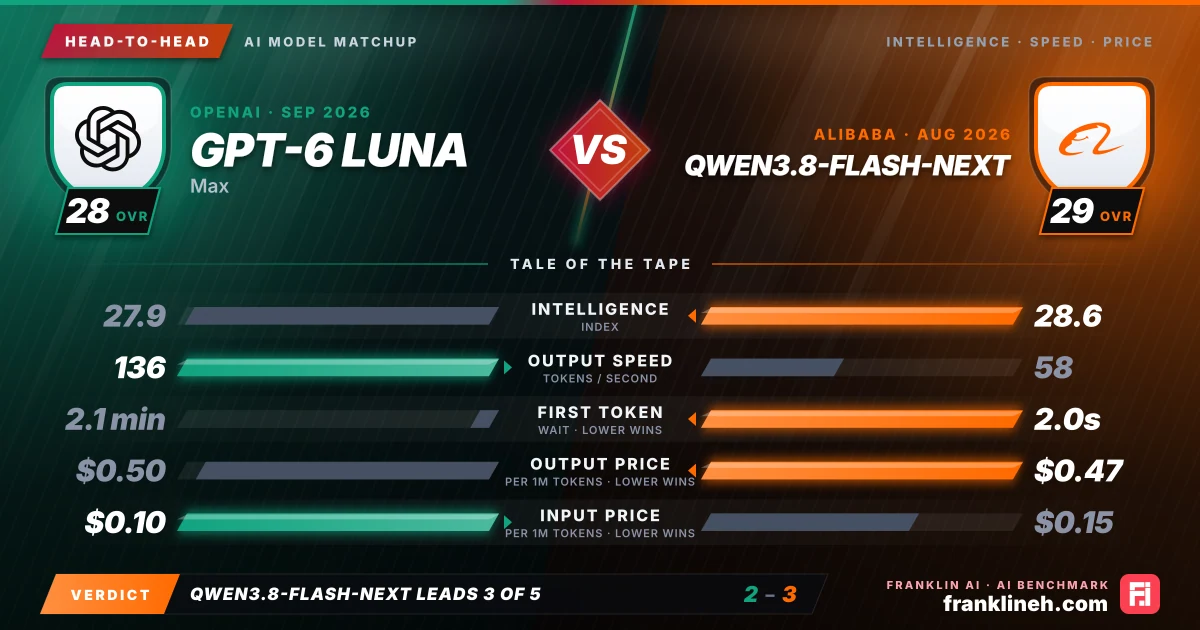
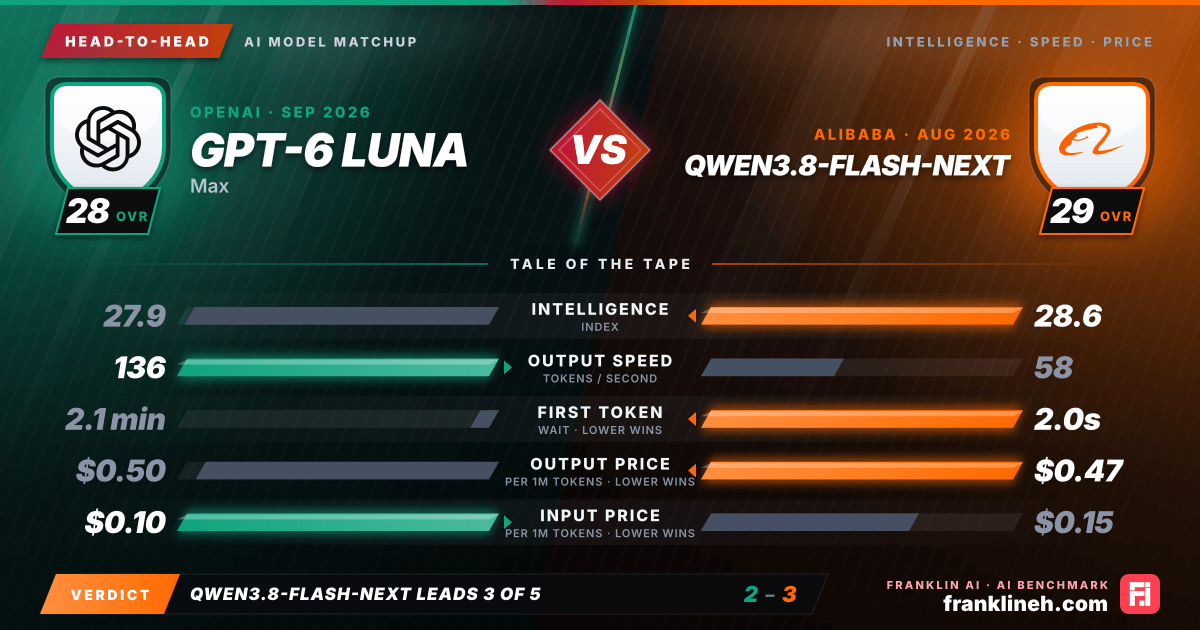
Head-to-head AI model comparison graphic: GPT-6 Luna (OpenAI) vs Qwen3.8-Flash-Next (Alibaba). Intelligence index 27.9 vs 28.5; output speed 141 vs 89 tokens per second; time to first token 90s vs 2.1s; output price $0.50 vs $0.47 per million tokens; input price $0.10 vs $0.15 per million tokens. franklineh.com
GPT-6 Luna vs Qwen3.8-Flash-Next: head-to-head AI benchmark comparison. Qwen3.8-Flash-Next leads on intelligence index, time to first token and output price; GPT-6 Luna leads on output speed and input price.
Head to headUpdated

GPT-6 Luna Max vs Qwen3.8-Flash-Next: which responds faster?

Qwen3.8-Flash-Next leads the intelligence index 28.5 to 27.9. GPT-6 Luna Max costs 13% less on blended price. Compare price, speed, latency and a clear verdict.

Pick it for GPT-6 Luna · Max

  • Lower cost: $0.20 against $0.24 for 1 million input and 200,000 output tokens.
  • Higher throughput once writing (141 tokens per second against 89 tokens per second), though it only finishes first beyond about 21,000 tokens.

Pick it for Qwen3.8-Flash-Next

  • Shorter wait for the first token: 2.1 seconds against 90 seconds.
  • Finishes a typical reply sooner: about 13 seconds against 97 seconds for 1,000 tokens, counting the first-token wait.

By the numbers

These figures describe the two model configurations shown here. A dash means the source snapshot had no usable figure for that metric. Scores, speed and API pricing may change as providers update models.

MetricGPT-6 Luna (Max)Qwen3.8-Flash-Next
Intelligence Index27.928.5
Input price (per 1M tokens)$0.10$0.15
Output price (per 1M tokens)$0.50$0.47
Output speed (tokens/s)14189
Time to first token90s2.1s
Release date2026-09-222026-08-26

There is very little daylight between GPT-6 Luna (Max) (OpenAI) and Qwen3.8-Flash-Next (Alibaba) on the overall index. The widest gap is the wait for the first token: 2.1 seconds for Qwen3.8-Flash-Next against 90 seconds for GPT-6 Luna Max. The figures come from tracked catalogue data, not from our own testing, so treat them as a starting point for a trial on your tasks.

GPT-6 Luna Max is the faster writer

Measured output speed is 141 tokens per second for GPT-6 Luna Max and 89 tokens per second for Qwen3.8-Flash-Next. That makes GPT-6 Luna Max roughly 1.6 times as fast at writing. Before any text appears, GPT-6 Luna Max takes 90 seconds and Qwen3.8-Flash-Next 2.1 seconds. The faster writer, GPT-6 Luna Max, gives away too much at the start to win on time: counting the first-token wait, Qwen3.8-Flash-Next finishes first for any reply shorter than about 21,000 tokens. A first-token wait of that length suits background work better than live conversation.

For a 1,000-token response, first token plus generation comes to roughly 97 seconds on GPT-6 Luna Max and 13 seconds on Qwen3.8-Flash-Next.

What they cost

The list prices are $0.10 in and $0.50 out for GPT-6 Luna Max, and $0.15 in and $0.47 out for Qwen3.8-Flash-Next, per million tokens. The rates cross over. GPT-6 Luna Max is cheaper to feed and Qwen3.8-Flash-Next is cheaper to hear back from.

A reference job of 1 million input tokens and 200,000 output tokens costs $0.20 with GPT-6 Luna Max and $0.24 with Qwen3.8-Flash-Next, so GPT-6 Luna Max saves $0.044. For classifying 100,000 short messages at 150 input tokens and 5 output tokens each, GPT-6 Luna Max would come in 30% lower: $1.75 for GPT-6 Luna Max against $2.48 for Qwen3.8-Flash-Next. Blended at three input tokens per output token, the effective rates are $0.20 for GPT-6 Luna Max and $0.23 for Qwen3.8-Flash-Next.

Reasoning and overall scores

The catalogue puts GPT-6 Luna Max at 27.9 and Qwen3.8-Flash-Next at 28.5 on its intelligence index. On an aggregate like this, under a point is effectively level.

Among 155 active scored models, GPT-6 Luna Max sits 89th and Qwen3.8-Flash-Next 87th.

There are no coding or math index scores for either model in the catalogue, which keeps this comparison at the aggregate level.

Value for money

Dividing the blended price by the intelligence index gives a rough cost per point: $0.0072 for GPT-6 Luna Max and $0.0081 for Qwen3.8-Flash-Next, per million tokens. Qwen3.8-Flash-Next costs 1.1 times as much per point, which is the price of its lead.

Which is newer

Qwen3.8-Flash-Next came first, on August 26, 2026; GPT-6 Luna Max followed on September 22, 2026. That is close enough to count them as the same generation.

Quick answers

Is GPT-6 Luna Max better than Qwen3.8-Flash-Next?

Not across the board: Qwen3.8-Flash-Next scores higher on the intelligence index, 28.5 to 27.9; GPT-6 Luna Max is 13% cheaper on blended price; GPT-6 Luna Max streams output 1.6 times as fast; and Qwen3.8-Flash-Next reaches its first token sooner.

Was this comparison tested by hand?

The figures are the recorded benchmark, price and speed data in Franklin AI's model catalogue. This page is written from that data automatically; neither model was tested by hand for it.

Which is cheaper, GPT-6 Luna Max or Qwen3.8-Flash-Next?

GPT-6 Luna Max is cheaper on a blended basis. GPT-6 Luna Max lists $0.10 per million input tokens and $0.50 per million output tokens; Qwen3.8-Flash-Next lists $0.15 and $0.47. For 1 million input and 200,000 output tokens that is $0.20 against $0.24.

Does GPT-6 Luna Max respond faster than Qwen3.8-Flash-Next?

GPT-6 Luna Max generates output faster, at 141 tokens per second against 89 tokens per second. Qwen3.8-Flash-Next reaches its first token sooner (2.1 seconds against 90 seconds). Counting the first-token wait, Qwen3.8-Flash-Next finishes first for any reply shorter than about 21,000 tokens.

Are GPT-6 Luna Max and Qwen3.8-Flash-Next from the same company?

GPT-6 Luna Max is made by OpenAI and Qwen3.8-Flash-Next by Alibaba. GPT-6 Luna Max was released on September 22, 2026 and Qwen3.8-Flash-Next on August 26, 2026.

Final whistle

Bottom line: Qwen3.8-Flash-Next is the stronger all-round pick on this data, while GPT-6 Luna Max makes sense in narrower cases. Pick Qwen3.8-Flash-Next if users are waiting on the first word and replies need to finish sooner at typical lengths. Pick GPT-6 Luna Max if cost matters ($0.50 against $0.47 per million output tokens) and you generate very long outputs, beyond about 21,000 tokens.

Where the numbers come from

The scores, speed and prices in this comparison come from independent third-party model evaluations that Franklin AI syncs each day, and the article was written from a snapshot of them. For the latest results, open the GPT-6 Luna (Max) and Qwen3.8-Flash-Next pages. The AI Benchmark methodology explains how that data is collected and shown.

Comments (0)

No comments yet

Be the first to share your thoughts!