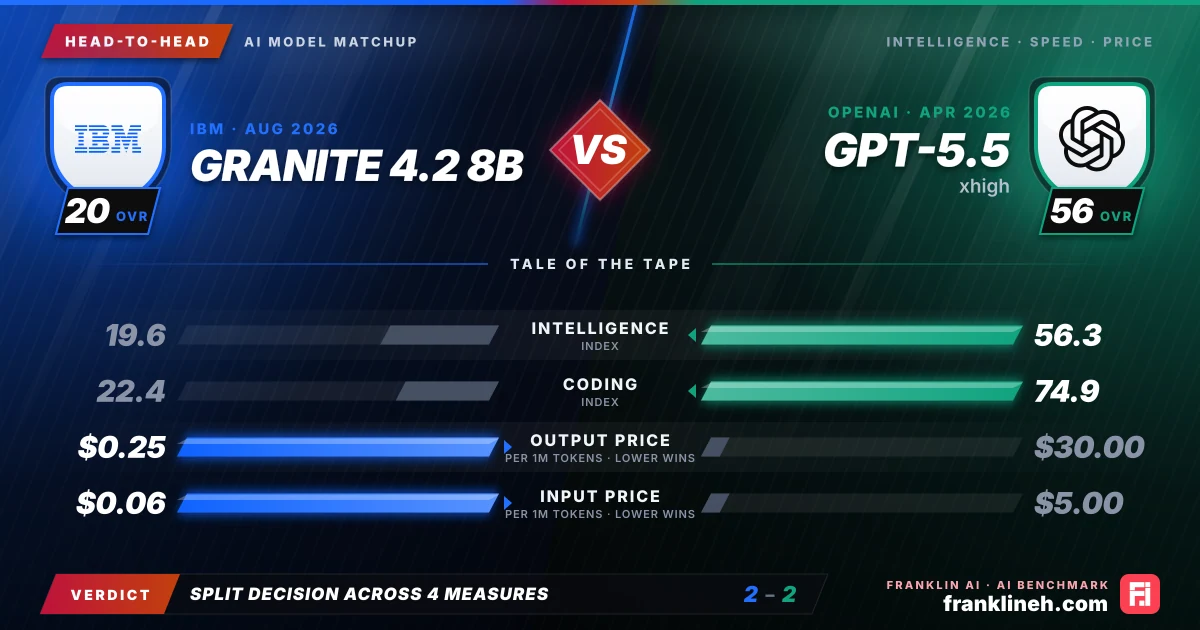
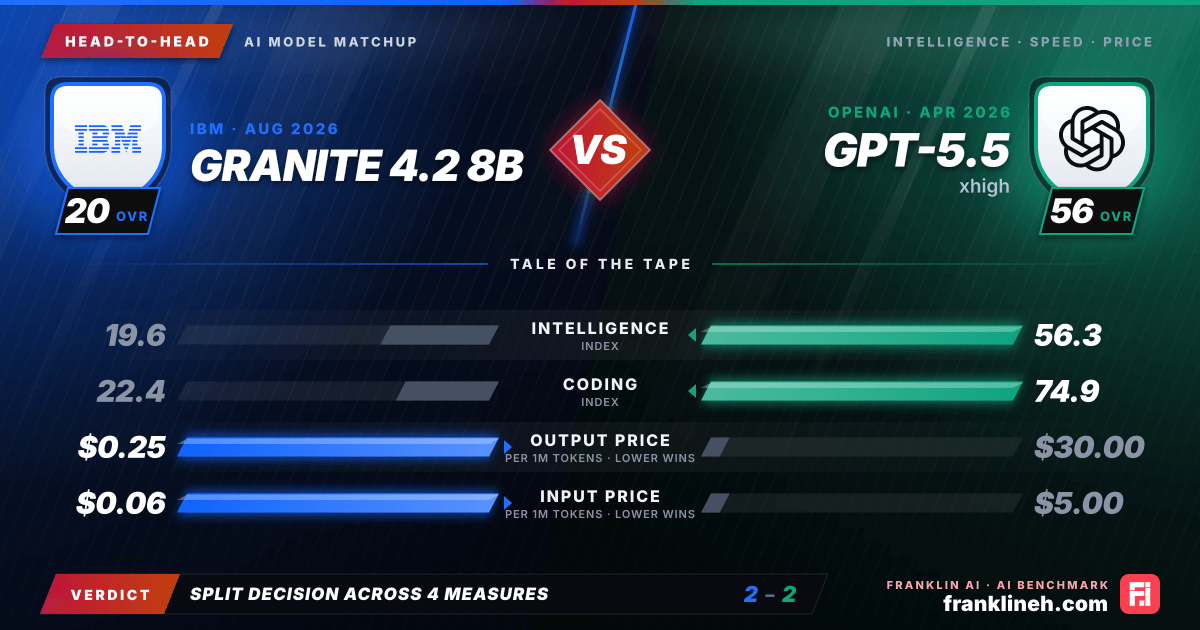
Head-to-head AI model comparison graphic: Granite 4.2 8B (IBM) vs GPT-5.5 (OpenAI). Intelligence index 19.6 vs 56.3; coding index 22.4 vs 74.9; output price $0.25 vs $30.00 per million tokens; input price $0.06 vs $5.00 per million tokens. franklineh.com
Granite 4.2 8B vs GPT-5.5: head-to-head AI benchmark comparison. Granite 4.2 8B leads on output price and input price; GPT-5.5 leads on intelligence index and coding index.
Head to headUpdated

Granite 4.2 8B vs. GPT-5.5 (xhigh): A Comparative Analysis

This analysis compares IBM’s Granite 4.2 8B and OpenAI’s GPT-5.5 (xhigh), evaluating their performance benchmarks, operational costs, and speed to help users determine the optimal model for their specific technical and budgetary requirements.

Pick it for Granite 4.2 8B

  • Longer responses where sustained output speed matters
  • Higher-volume workloads where blended token cost matters
  • Teams already standardized on IBM

Pick it for GPT-5.5 · Xhigh

  • Workloads that benefit from the stronger overall intelligence score
  • Coding and agentic tasks where the benchmark edge matters
  • Latency-sensitive chat, support, and interactive product flows

By the numbers

These figures describe the two model configurations shown here. A dash means the source snapshot had no usable figure for that metric. Scores, speed and API pricing may change as providers update models.

MetricGranite 4.2 8BGPT-5.5 (xhigh)
Intelligence Index19.656.3
Coding Index22.474.9
Input price (per 1M tokens)$0.06$5.00
Output price (per 1M tokens)$0.25$30.00
Output speed (tokens/s)105–
Time to first token0.24s–
Release date2026-08-252026-04-23

Understanding the Benchmark Landscape

The performance gap between IBM’s Granite 4.2 8B and OpenAI’s GPT-5.5 (xhigh) is significant, reflecting their distinct design goals. GPT-5.5 (xhigh) demonstrates superior reasoning capabilities, evidenced by an intelligence index of 56.3 compared to Granite’s 19.6. This disparity is further highlighted in specialized benchmarks; GPT-5.5 achieves a 0.935 on GPQA and a 0.561 on SciCode, while Granite 4.2 8B scores 0.631 and 0.304, respectively. For users engaged in complex scientific research or advanced coding tasks, GPT-5.5 (xhigh) provides a depth of analysis that the smaller Granite model cannot match. However, Granite remains a capable tool for lighter tasks, maintaining a coding index of 22.4, which suggests it is well-suited for routine programming support rather than architectural-level problem solving.

Speed and Cost Efficiency

Operational efficiency is where the two models diverge most sharply. IBM’s Granite 4.2 8B is built for speed and affordability, boasting an output speed of 104.966 tokens per second and a rapid time-to-first-token of 0.236 seconds. At a blended cost of $0.11 per million tokens, it is an accessible option for high-volume applications where latency is a critical factor. In contrast, OpenAI’s GPT-5.5 (xhigh) commands a premium price, with a blended cost of $11.25 per million tokens—roughly 100 times more expensive than Granite. While OpenAI has not disclosed specific speed metrics for this model, the significant investment required for its use suggests it is intended for high-value, low-volume reasoning tasks rather than high-throughput, real-time streaming applications.

Aligning Models with Workflows

Selecting the right model requires balancing the need for raw capability against the constraints of your project budget. GPT-5.5 (xhigh) is best suited for workflows that require high-level logical deduction, such as complex software engineering, academic research, or tasks requiring strict adherence to intricate instructions, as evidenced by its strong performance in benchmarks like IFBench and TAU2. It is a specialized tool for when accuracy is the primary objective and cost is a secondary concern.

Conversely, Granite 4.2 8B is an ideal candidate for developers and enterprises looking to integrate AI into applications where cost-per-request and latency are the primary constraints. Its performance profile makes it an excellent choice for lightweight coding assistants, internal documentation retrieval, or any system that requires high-frequency inference without the overhead of a massive, expensive model. By choosing Granite, organizations can deploy AI at scale while maintaining a predictable and manageable cost structure, provided the task complexity remains within the model's operational capabilities.

Quick answers

Is Granite 4.2 8B better than GPT-5.5 xhigh?

Neither wins everywhere: GPT-5.5 xhigh scores higher on the intelligence index, 56.3 to 19.6; and Granite 4.2 8B is 99% cheaper on blended price.

Which is better for coding, GPT-5.5 xhigh or Granite 4.2 8B?

GPT-5.5 xhigh has the higher coding index, 74.9 against 22.4.

When were GPT-5.5 xhigh and Granite 4.2 8B released?

Granite 4.2 8B is newer. It was released on August 25, 2026, about 4 months after GPT-5.5 xhigh (April 23, 2026).

Are GPT-5.5 xhigh and Granite 4.2 8B from the same company?

GPT-5.5 xhigh is made by OpenAI and Granite 4.2 8B by IBM. GPT-5.5 xhigh was released on April 23, 2026 and Granite 4.2 8B on August 25, 2026.

How much do GPT-5.5 xhigh and Granite 4.2 8B cost?

Granite 4.2 8B is cheaper on a blended basis. GPT-5.5 xhigh lists $5.00 per million input tokens and $30.00 per million output tokens; Granite 4.2 8B lists $0.06 and $0.25. For 1 million input and 200,000 output tokens that is $11.00 against $0.11.

Final whistle

The choice between these models depends on your tolerance for cost versus the necessity for peak intelligence. GPT-5.5 (xhigh) is a powerhouse for complex reasoning and coding, justifying its premium price for high-stakes tasks. Conversely, Granite 4.2 8B offers a highly efficient, low-cost alternative for developers who prioritize speed and budget-conscious deployment. If your workflow demands maximum accuracy, OpenAI is the clear leader; if you require rapid, cost-effective inference, IBM provides the superior value proposition.

Where the numbers come from

The scores, speed and prices in this comparison come from independent third-party model evaluations that Franklin AI syncs each day, and the article was written from a snapshot of them. For the latest results, open the Granite 4.2 8B and GPT-5.5 (xhigh) pages. The AI Benchmark methodology explains how that data is collected and shown.

Comments (0)

No comments yet

Be the first to share your thoughts!