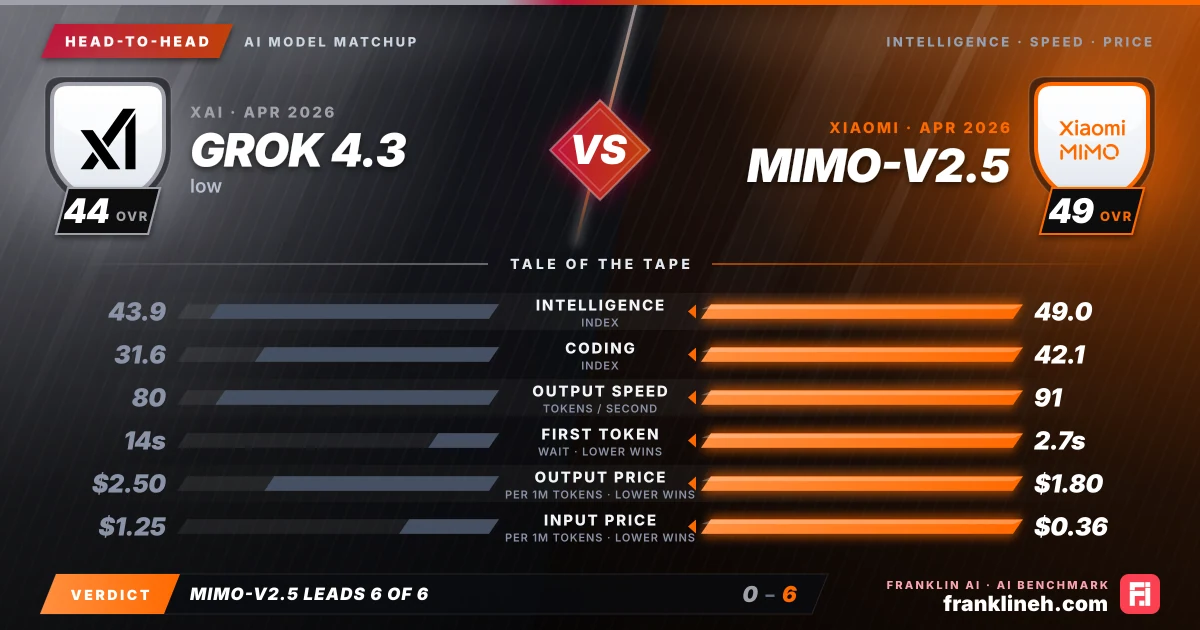
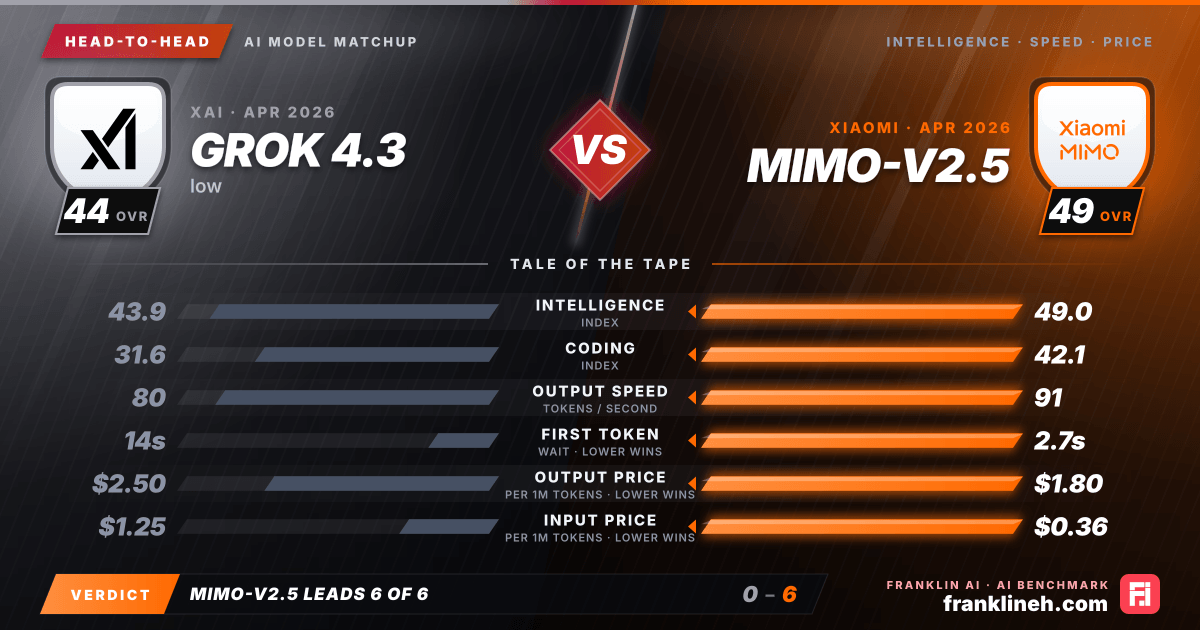
Head-to-head AI model comparison graphic: Grok 4.3 (xAI) vs MiMo-V2.5 (Xiaomi). Intelligence index 43.9 vs 49.0; coding index 31.6 vs 42.1; output speed 80 vs 91 tokens per second; time to first token 14s vs 2.7s; output price $2.50 vs $1.80 per million tokens; input price $1.25 vs $0.36 per million tokens. franklineh.com
Grok 4.3 vs MiMo-V2.5: head-to-head AI benchmark comparison. MiMo-V2.5 leads on intelligence index, coding index, output speed, time to first token, output price and input price.
Head to headUpdated

Grok 4.3 (low) vs MiMo-V2.5

MiMo-V2.5 outperforms Grok 4.3 (low) across nearly all intelligence and coding benchmarks while offering significantly lower pricing and faster response times, making it the superior technical choice for most users.

Pick it for Grok 4.3 · Low

  • Instruction following tasks
  • LCR benchmark requirements
  • Specialized xAI workflows

Pick it for MiMo-V2.5

  • High-speed coding tasks
  • Cost-sensitive applications
  • Low-latency response needs

By the numbers

These figures describe the two model configurations shown here. A dash means the source snapshot had no usable figure for that metric. Scores, speed and API pricing may change as providers update models.

MetricGrok 4.3 (low)MiMo-V2.5
Intelligence Index43.949.0
Coding Index31.642.1
Input price (per 1M tokens)$1.25$0.36
Output price (per 1M tokens)$2.50$1.80
Output speed (tokens/s)8091
Time to first token14s2.7s
Release date2026-04-302026-04-22

Quick Take

Released in late April 2026, both models represent the latest in AI development. MiMo-V2.5 by Xiaomi establishes a clear lead in core performance metrics, while xAI’s Grok 4.3 (low) offers a competitive alternative with a distinct performance profile.

Benchmark Read

MiMo-V2.5 leads in the primary intelligence and coding indices, scoring 49 and 42.1 respectively, compared to Grok 4.3 (low)’s 43.9 and 31.6. In specific benchmarks, MiMo-V2.5 shows superior results in HLE (0.252 vs 0.173), SciCode (0.431 vs 0.419), TerminalBench Hard (0.416 vs 0.265), and TAU2 (0.906 vs 0.888). Grok 4.3 (low) holds a slight advantage in IFBench (0.809 vs 0.671) and LCR (0.64 vs 0.626). Math index data remains unavailable for both models.

Cost and Speed

MiMo-V2.5 is significantly more cost-effective, with a blended price of $0.72/1M tokens compared to Grok 4.3 (low)’s $1.56/1M. Xiaomi’s model also delivers faster output speeds at 91.485 tok/s versus 80.284 tok/s. Most notably, MiMo-V2.5 offers a time to first token of 2.699s, drastically outperforming Grok 4.3 (low)’s 13.852s, which may impact real-time application responsiveness.

Best Fit

Grok 4.3 (low) is best suited for users who prioritize performance on specific instruction-following tasks (IFBench) and LCR benchmarks. MiMo-V2.5 is the ideal choice for developers and enterprises seeking high-speed, cost-efficient coding assistance and superior general intelligence performance.

Quick answers

Is Grok 4.3 low better than MiMo-V2.5?

Where the data separates them, MiMo-V2.5 is ahead each time: MiMo-V2.5 scores higher on the intelligence index, 49.0 to 43.9; MiMo-V2.5 is 54% cheaper on blended price; and MiMo-V2.5 streams output 1.1 times as fast.

Which is newer, Grok 4.3 low or MiMo-V2.5?

Grok 4.3 low is newer. It was released on April 30, 2026, 8 days after MiMo-V2.5 (April 22, 2026).

How much do Grok 4.3 low and MiMo-V2.5 cost?

MiMo-V2.5 is cheaper on a blended basis. Grok 4.3 low lists $1.25 per million input tokens and $2.50 per million output tokens; MiMo-V2.5 lists $0.36 and $1.80. For 1 million input and 200,000 output tokens that is $1.75 against $0.72.

Who makes Grok 4.3 low and MiMo-V2.5?

Grok 4.3 low is made by xAI and MiMo-V2.5 by Xiaomi. Grok 4.3 low was released on April 30, 2026 and MiMo-V2.5 on April 22, 2026.

Which model has lower latency?

MiMo-V2.5 generates output faster, at 91 tokens per second against 80 tokens per second. MiMo-V2.5 reaches its first token sooner (2.7 seconds against 14 seconds).

Final whistle

For most users, MiMo-V2.5 is the clear winner. It provides higher intelligence and coding scores, faster token generation, and lower costs. Grok 4.3 (low) is only recommended if your specific workflow requires the unique performance profile of its architecture, as it currently lags behind Xiaomi’s offering in both speed and efficiency metrics.

Where the numbers come from

The scores, speed and prices in this comparison come from independent third-party model evaluations that Franklin AI syncs each day, and the article was written from a snapshot of them. For the latest results, open the Grok 4.3 (low) and MiMo-V2.5 pages. The AI Benchmark methodology explains how that data is collected and shown.

Comments (0)

No comments yet

Be the first to share your thoughts!