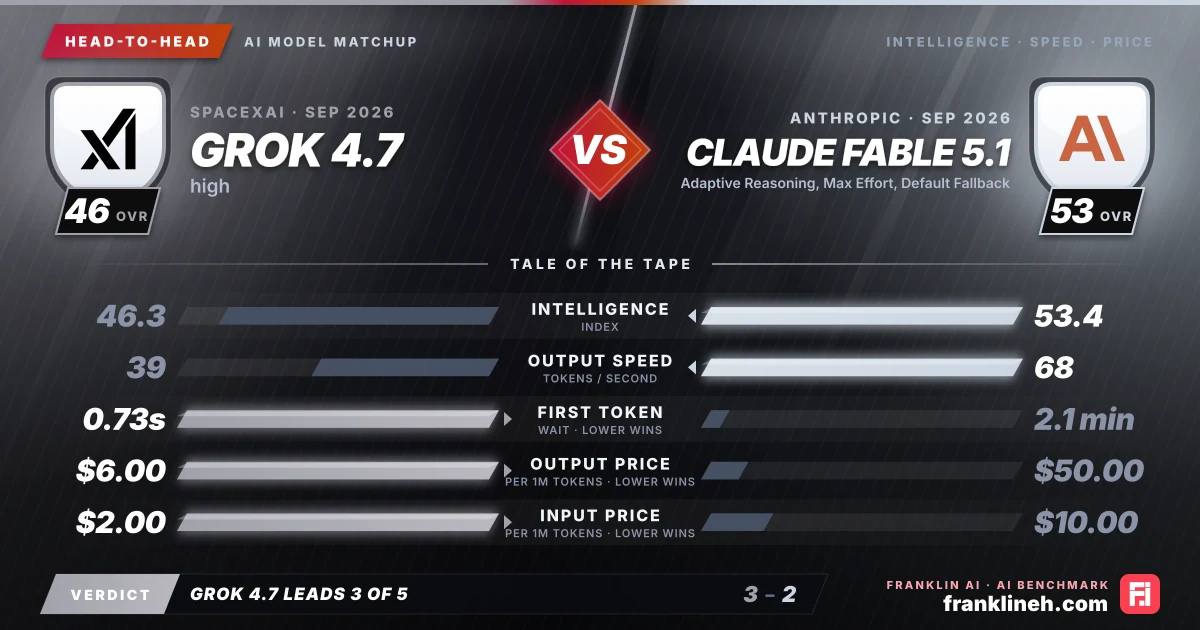
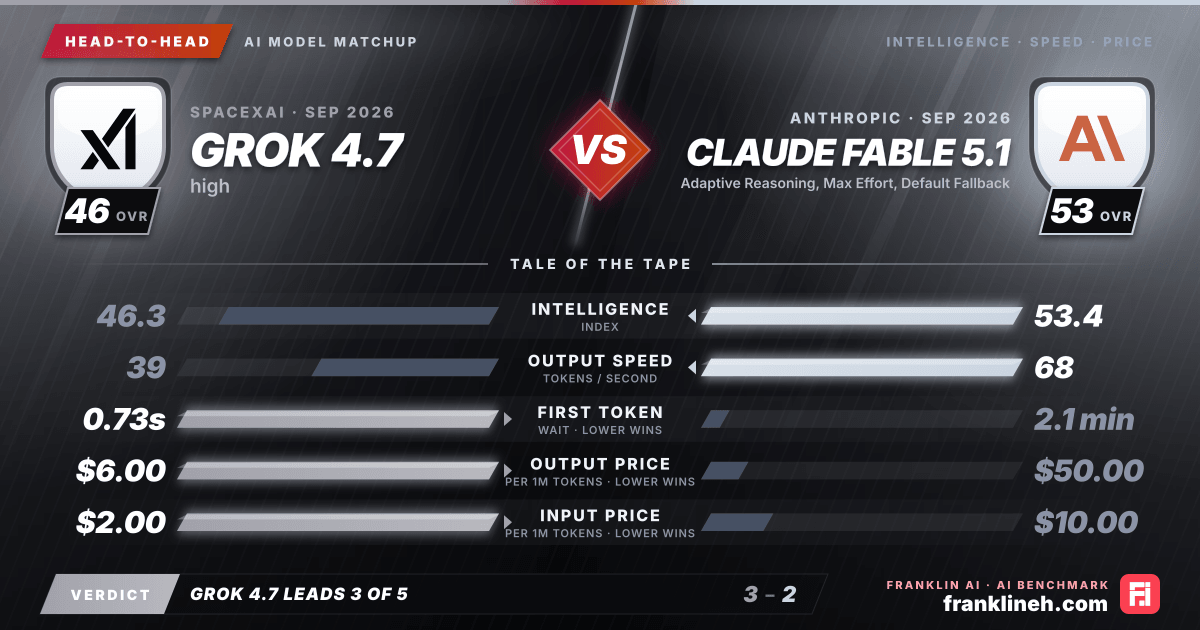
Head-to-head AI model comparison graphic: Grok 4.7 (SpaceXAI) vs Claude Fable 5.1 (Anthropic). Intelligence index 46.3 vs 53.4; output speed 39 vs 68 tokens per second; time to first token 0.73s vs 2.1 min; output price $6.00 vs $50.00 per million tokens; input price $2.00 vs $10.00 per million tokens. franklineh.com
Grok 4.7 vs Claude Fable 5.1: head-to-head AI benchmark comparison. Grok 4.7 leads on time to first token, output price and input price; Claude Fable 5.1 leads on intelligence index and output speed.
Head to headUpdated

Grok 4.7 vs. Claude Fable 5.1: A Comparative Analysis

This comparison evaluates the performance, cost, and architectural tradeoffs between SpaceXAI’s Grok 4.7 and Anthropic’s Claude Fable 5.1. While Claude Fable 5.1 offers superior reasoning and coding capabilities, Grok 4.7 provides a significantly more cost-effective and responsive alternative for high-volume tasks.

Pick it for Grok 4.7 · High

  • Latency-sensitive chat, support, and interactive product flows
  • Higher-volume workloads where blended token cost matters
  • Teams already standardized on SpaceXAI

Pick it for Claude Fable 5.1 · Adaptive Reasoning, Max Effort, Default Fallback

  • Workloads that benefit from the stronger overall intelligence score
  • Coding and agentic tasks where the benchmark edge matters
  • Longer responses where sustained output speed matters

By the numbers

MetricGrok 4.7 (high)Claude Fable 5.1 (Adaptive Reasoning, Max Effort, Default Fallback)
Intelligence Index46.353.4
Coding Index–81.6
Input price (per 1M tokens)$2.00$10.00
Output price (per 1M tokens)$6.00$50.00
Output speed (tokens/s)3968
Time to first token0.73s2.1 min
Release date2026-09-212026-09-01

What the benchmarks show

When evaluating the raw intelligence of these two models, the data suggests a clear performance gap. Claude Fable 5.1, released on September 1, 2026, holds an intelligence index of 53.4, significantly outpacing the Grok 4.7’s index of 46.3. This lead is reflected across standardized testing metrics. In the HLE benchmark, Claude Fable 5.1 achieves a score of 0.591 compared to Grok 4.7’s 0.423. Similarly, Claude Fable 5.1 demonstrates stronger performance in the SciCode and LCR benchmarks, scoring 0.631 and 0.853 respectively, while Grok 4.7 trails with 0.578 and 0.77. Furthermore, Claude Fable 5.1 boasts a coding index of 81.6, establishing it as a more robust tool for software development tasks.

Speed and cost

Operational efficiency reveals a stark contrast between the two models. Grok 4.7 is optimized for speed and accessibility, offering an output speed of 38.606 tokens per second and a remarkably low time to first token of 0.732 seconds. This makes it ideal for real-time applications where user experience depends on immediate feedback. In contrast, Claude Fable 5.1, while faster in raw output speed at 67.799 tokens per second, suffers from a substantial time to first token of 123.03 seconds, which may hinder interactive or conversational workflows.

Financial considerations further differentiate the models. Grok 4.7 is positioned as a high-value option with a blended cost of $3.00 per million tokens. Claude Fable 5.1 commands a premium, with a blended cost of $20.00 per million tokens—nearly seven times the price of Grok 4.7. Organizations must decide if the increased reasoning capabilities of the Claude architecture justify this significant increase in operational expenditure.

Which model fits which workflow

Choosing between these models requires balancing technical capability against resource constraints. Claude Fable 5.1 is designed for complex, high-stakes environments where accuracy, logical reasoning, and coding proficiency are paramount. Its performance in benchmarks suggests it is better suited for deep analysis, research, and intricate programming tasks where the cost per token is secondary to the quality of the output.

Grok 4.7 serves a different segment of the market. Its architecture is tailored for high-throughput environments where latency is a critical factor. Because it provides near-instantaneous responses at a fraction of the cost, it is better suited for customer-facing chatbots, automated data processing pipelines, and large-scale applications where budget management is essential. The model’s lower intelligence index is a trade-off for its superior accessibility and speed.

Decision takeaway

Ultimately, the decision rests on the specific requirements of your deployment. If your workflow involves complex problem-solving or software engineering that benefits from the 81.6 coding index, Claude Fable 5.1 is the superior instrument. Conversely, if your project requires a high-volume, low-latency solution that keeps operational costs predictable, Grok 4.7 offers a more balanced profile. There is no universal winner; rather, there is a clear distinction between a premium reasoning engine and a high-efficiency utility model.

Frequently asked questions

Is Grok 4.7 high better than Claude Fable 5.1 Adaptive Reasoning?

Not across the board: Claude Fable 5.1 Adaptive Reasoning scores higher on the intelligence index, 53.4 to 46.3; Grok 4.7 high is 85% cheaper on blended price; Claude Fable 5.1 Adaptive Reasoning streams output 1.8 times as fast; and Grok 4.7 high reaches its first token sooner.

Who makes Claude Fable 5.1 Adaptive Reasoning and Grok 4.7 high?

Claude Fable 5.1 Adaptive Reasoning is made by Anthropic and Grok 4.7 high by SpaceXAI. Claude Fable 5.1 Adaptive Reasoning was released on September 1, 2026 and Grok 4.7 high on September 21, 2026.

When were Claude Fable 5.1 Adaptive Reasoning and Grok 4.7 high released?

Grok 4.7 high is newer. It was released on September 21, 2026, 20 days after Claude Fable 5.1 Adaptive Reasoning (September 1, 2026).

Which is cheaper, Claude Fable 5.1 Adaptive Reasoning or Grok 4.7 high?

Grok 4.7 high is cheaper on a blended basis. Claude Fable 5.1 Adaptive Reasoning lists $10.00 per million input tokens and $50.00 per million output tokens; Grok 4.7 high lists $2.00 and $6.00. For 1 million input and 200,000 output tokens that is $20.00 against $3.20.

Is Claude Fable 5.1 Adaptive Reasoning or Grok 4.7 high better at coding?

The catalogue has no coding index for Grok 4.7 high yet, so there is no direct coding comparison. The closest signal is the overall intelligence index, 53.4 for Claude Fable 5.1 Adaptive Reasoning and 46.3 for Grok 4.7 high.

Final whistle

The choice between these models depends on the priority of your workload. If your application requires high-level reasoning and complex coding assistance, Claude Fable 5.1 is the clear technical leader. However, if your project demands rapid, low-latency responses and budget efficiency, Grok 4.7 is the more practical choice. Users should weigh the significant cost premium of Claude against its performance gains to determine if the increased intelligence index justifies the expenditure for their specific use case.

Where the numbers come from

The scores, speed and prices in this comparison come from independent third-party model evaluations that Franklin AI syncs each day, and the article was written from a snapshot of them. For the latest results, open the Grok 4.7 (high) and Claude Fable 5.1 (Adaptive Reasoning, Max Effort, Default Fallback) pages. The AI Benchmark methodology explains how that data is collected and shown.

Comments (0)

No comments yet

Be the first to share your thoughts!