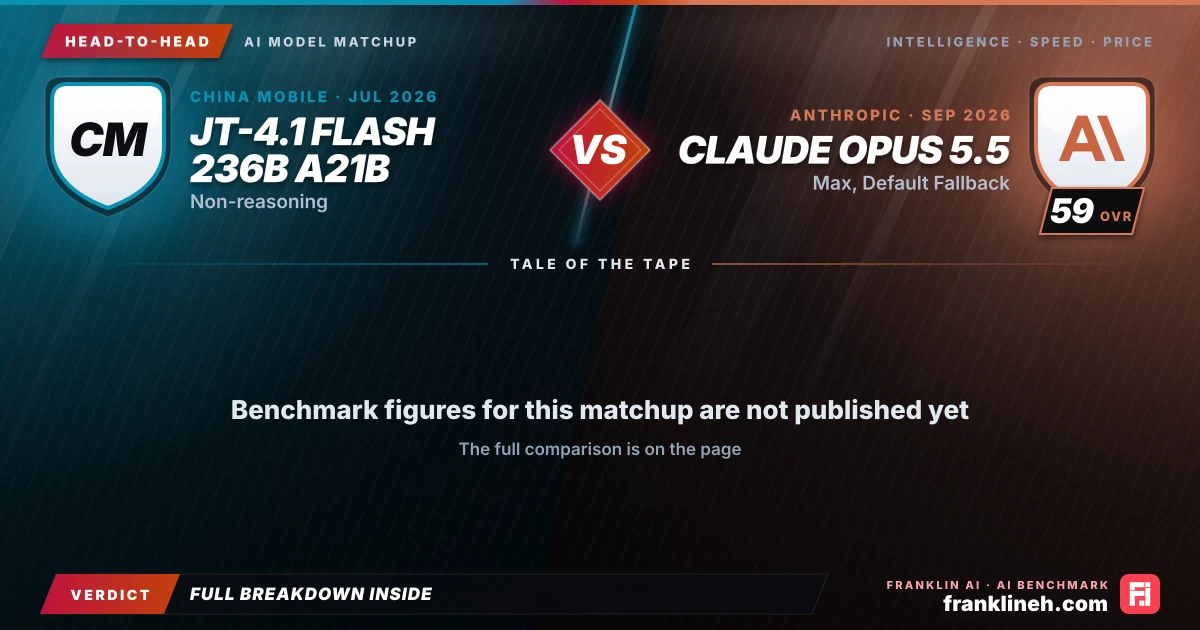
JT-4.1 Flash 236B A21B (Non-reasoning) vs Claude Opus 5.5 (Max, Default Fallback)
JT-4.1 Flash 236B A21B (Non-reasoning) vs Claude Opus 5.5 (Max, Default Fallback): JT-4.1 Flash lacks the recorded scores and prices needed for a full numerical comparison with Opus Max.
Pick it for Claude Opus 5.5 · Max, Default Fallback
An evaluation that needs a documented aggregate intelligence result while the first variant’s result remains unreported.
By the numbers
These figures describe the two model configurations shown here. A dash means the source snapshot had no usable figure for that metric. Scores, speed and API pricing may change as providers update models.
JT-4.1 Flash 236B A21B (Non-reasoning) and Claude Opus 5.5 (Max, Default Fallback) are compared using Franklin’s captured benchmark records, reviewed on November 6, 2026.
What do the recorded results and rates show?
JT-4.1 Flash 236B A21B in its Non-reasoning configuration has no intelligence-index value and no input or output token rates in this snapshot. Claude Opus 5.5 Max with Default Fallback records an intelligence index of 59.1 and rates of $4 input and $20 output per million tokens. These gaps are unavailable data, not zero-valued results or free access.
How should you use this comparison?
Before choosing between them, obtain JT’s current provider documentation and a task-specific evaluation. The Opus figures can describe Opus but cannot establish a numerical margin over missing JT measurements. Coding and math indexes are absent for both. Keep the Non-reasoning label in any test so a different configuration is not silently substituted for the record on this page.
Response speed, latency and release dates
How long do these model variants take to start responding?
The snapshot records time to first token as not recorded for JT-4.1 Flash 236B A21B (Non-reasoning) and 643.93 seconds for Claude Opus 5.5 (Max, Default Fallback). This is a response-start measurement, separate from output speed.
What output speeds are recorded for this pair?
Recorded output speed is not recorded for JT-4.1 Flash 236B A21B (Non-reasoning) and 94.22 tokens per second for Claude Opus 5.5 (Max, Default Fallback). An unavailable value remains unmeasured; it is not zero.
Which release dates belong to the compared variants?
The stored release dates are 2026-07-09 for JT-4.1 Flash 236B A21B (Non-reasoning) and 2026-09-22 for Claude Opus 5.5 (Max, Default Fallback). The archive page keeps its original publication date; these model facts were reviewed on November 6, 2026.
Final whistle
Treat this as a documented evidence gap: the snapshot supports Opus figures but cannot supply JT’s missing prices or quality measures.

Comments (0)
to join the discussion
No comments yet
Be the first to share your thoughts!