
Anthropic published experiments on agent memory on November 6, describing how Claude can save lessons from one session and read them in another. The research post also examines how revisiting transcripts between sessions can help an agent repair mistakes in its saved notes.
What Claude keeps between sessions
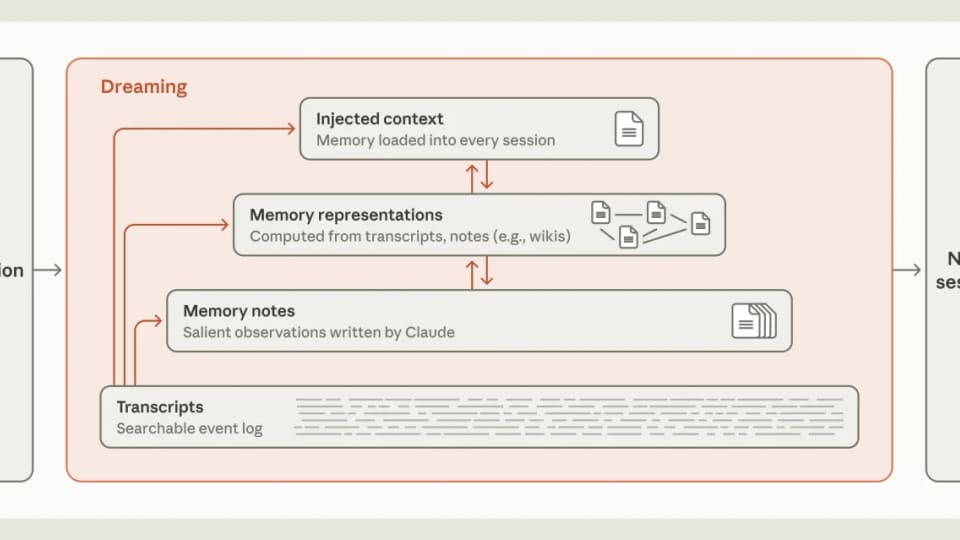
Anthropic separates memory notes from the raw transcripts that record an agent’s work. Notes can retain a fact or a rule the agent expects to need again. The report also describes more structured memory representations, such as wikis, and injected context that can be loaded at the start of a session.
Those layers serve different purposes. The transcript preserves the original sequence of events. A short note makes a selected lesson easier to retrieve. As the notes accumulate, Anthropic’s approach gives a later process a chance to reorganize them or check them against what happened.
How the database experiment worked
Anthropic used a CL-Bench 1.0 database task with Claude Managed Agents. Each question began in a fresh session, with access to files in a persistent memory directory. The agent received the correct answer after responding and could write down a lesson for a later question. Anthropic reports that Claude Opus 5.5 and Claude Sonnet 5.5 used the store to retain rules they had tested.
Why Anthropic checks the transcript
The report calls between-session memory processing dreaming. In one Pokémon experiment, Claude had saved an incorrect location. Reviewing the session transcript let it correct the note and change its route on the next attempt. That example shows why an agent’s stored summary benefits from a way to inspect the events that produced it.
For a team evaluating memory, a useful test would seed a plausible mistake in a note and see whether the agent detects and corrects it. The published examples describe specific experiments, with effects that depend on the model, task and memory setup.
