
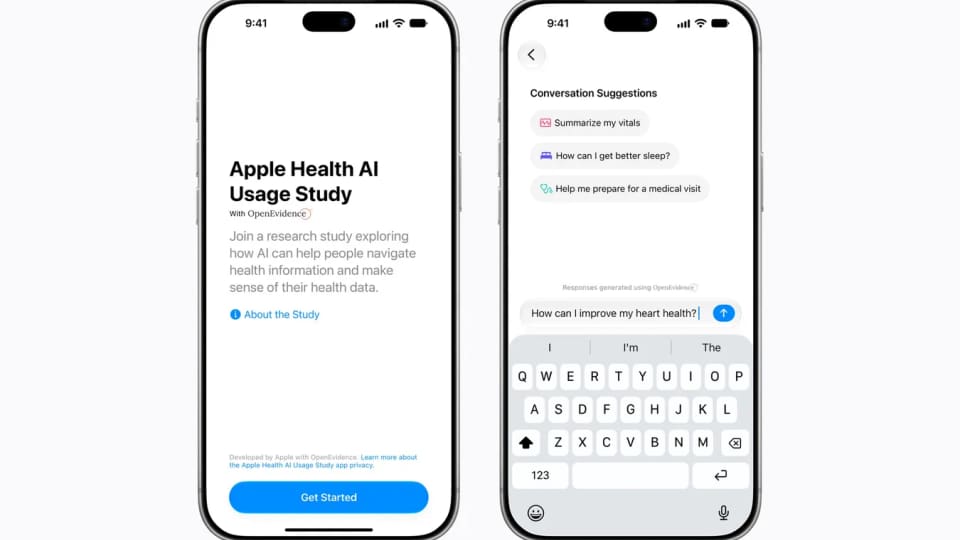
Apple announced the Apple Health AI Usage Study on November 15, 2026. The US virtual study, run with OpenEvidence, looks at how people judge conversational health AI answers and whether they understand the information they receive. Apple says it also wants to learn what drives trust and how people use the answers in everyday health decisions.
What people can do in the study app
Participants can ask everyday health questions and see links to peer-reviewed clinical sources alongside the answers. OpenEvidence supplies the health AI technology. Apple designed the research experience. The company says the study will explore how a conversation could help someone prepare for a visit with their own doctor.
Participants can choose whether to share HealthKit information. Apple lists examples such as resting heart rate, activity, sleep and lab results. The study examines whether adding those details affects how relevant or understandable a response is. That feature creates a useful distinction for the research. A participant may understand an answer equally well with or without a more personalized response.
Who can join
Apple says enrollment is open to up to 200,000 eligible US participants aged 21 or older. The study requires an Apple Intelligence-enabled iPhone, beginning with iPhone 15 Pro, running iOS 26 or later. Interested readers can reach the enrollment app through Apple's announcement and read the eligibility details there.
How Apple describes data use and safeguards
Apple says study data will not be used to train AI models. Participants decide whether to share HealthKit metrics or survey answers. Apple also says the app is designed to detect certain concerning questions and suggest contacting a provider or another resource where appropriate.
This is an enrollment announcement. Apple describes the questions it wants the study to answer and acknowledges that conversational tools can sometimes give incomplete or unclear responses. The announcement supplies no results about whether people understood the answers better or were better prepared for their visits.
