
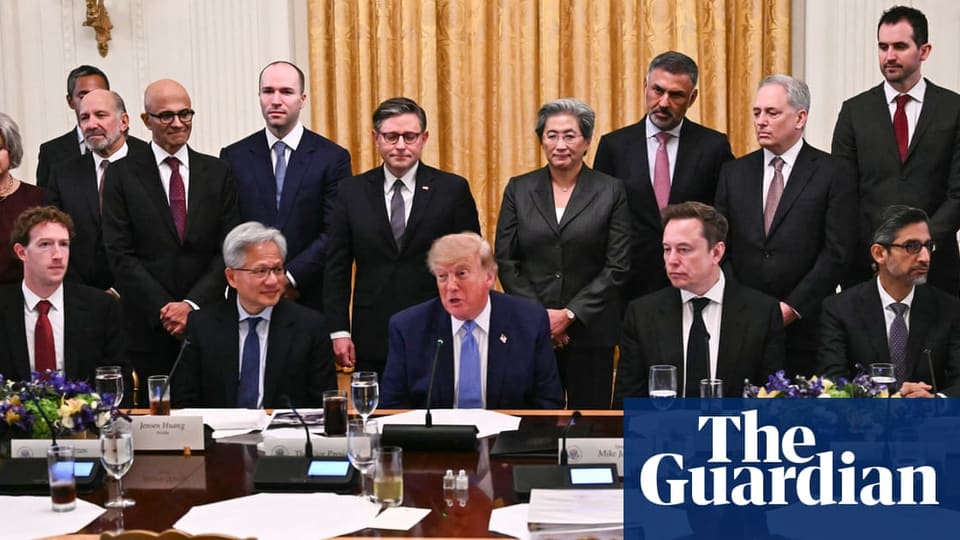
Donald Trump and six technology executives signed a voluntary AI safety accord at the White House on Tuesday, September 29. The document proposes company controls and external evaluation as the administration responds to concerns about the pace of AI development.
A misspelling beneath Trump's signature drew attention to the release: it identified him as president of the 'Unites States.' In Ariana Baio's reporting for the Guardian, the more consequential detail is the accord's reliance on companies to implement its safeguards. A signed commitment gives readers something to examine, but does not establish that the promised checks are already operating.
The safeguards companies are proposing
The Guardian reports that the accord describes four layers of controls and audits. Companies would use internal controls and work with an independent external auditor or evaluator. The reported proposals include teams that monitor whether AI operates as intended, alongside checks on access to technical systems involving cybersecurity, biosecurity and chemical threats.
External monitors would also examine performance. Companies could assign a board committee to oversee reports from teams running the controls. Those roles raise practical accountability questions: who gets access to the findings, how problems reach company leadership, and what an evaluator can inspect before giving an assessment. The article does not answer those questions for each signatory.
Internal monitoring and external evaluation address different parts of that process. Company employees can observe systems during development and operation; an outside evaluator introduces another set of judgments. Readers should look for evidence that the two activities have defined responsibilities rather than assuming the word 'audit' describes a completed safety examination.
A pledge with six industry signatories
The Guardian identifies the executive signatories as Anthropic's Dario Amodei, Elon Musk from SpaceXAI, OpenAI's Greg Brockman, Nvidia's Jensen Huang, Meta's Mark Zuckerberg and Google's Sundar Pichai. That company affiliation list comes from the Guardian's account. Their signatures document participation in the accord, not proof that their companies have implemented identical monitoring or evaluation arrangements.
The agreement is voluntary. The Guardian describes the possibility of turning its framework into formal regulations or laws, while reporting that Trump has opposed such regulation. A possible later rule should therefore be distinguished from the commitment signed this week. Readers and businesses should not treat this account as evidence of a new enforceable audit requirement.
Trump praised the executives' business growth at the signing and emphasized self-policing in remarks to reporters. That places the practical test with the companies for now: subsequent disclosures about controls, evaluators and oversight would help show what changes follow the signing. Participation alone leaves that question open.
Public concern and the document's limits
The Guardian places the accord alongside two polling findings. It reports that 61% of voters in a New York Times/Siena College poll opposed building data centers, and that 71% of Americans in an SSRS/CNN poll thought the government was doing too little to regulate AI's growth and development. These surveys ask different questions. Opposition to data-center construction cannot be treated as the same measurement as dissatisfaction with government oversight.
The misspelled document appeared on Trump's Truth Social account and went out through the White House communications team, according to the Guardian. Its report says the cause of the error, and whether it would appear in the Federal Register, were unclear. The newspaper had asked the White House for comment; the supplied report includes no response.
The useful follow-up is to examine how the proposed safety checks work in practice. An identified evaluator, a defined reporting route and disclosures about unresolved findings would make the commitment easier to assess. Until such evidence is available, the accord supports a narrower conclusion: these executives have endorsed a voluntary approach whose implementation still needs scrutiny.