
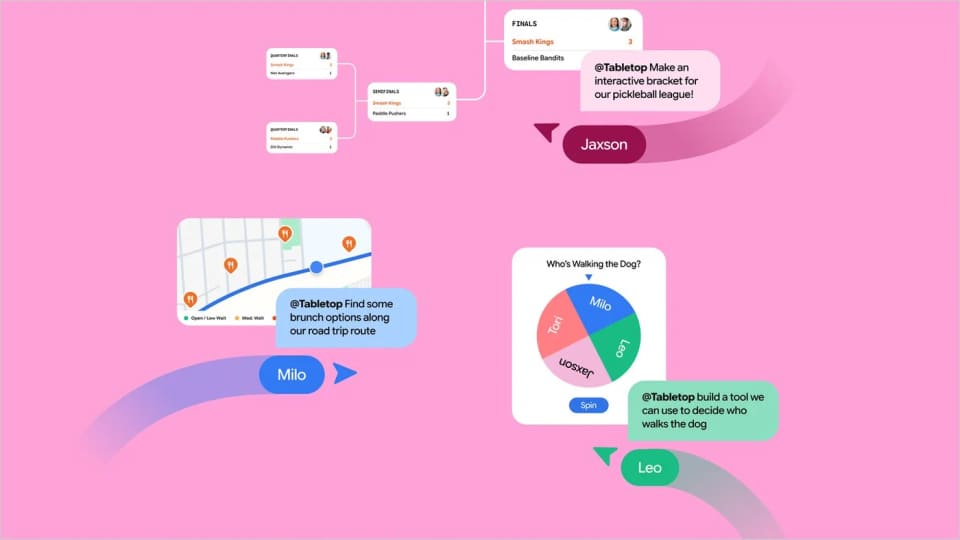
Google Labs announced Tabletop on November 11 as an experiment for groups that need a common place to plan. People can add links, files and ideas, then prompt Tabletop or start with a template. Google says the result is an interactive space that a group can use together in real time.
What a group can make
Google names trip itineraries, dinner polls, expense splitters and tournament brackets. These examples cover two different jobs: collecting information and giving a group a way to act on it. An itinerary can bring options into one place, while a poll or bracket gives participants a shared structure for making choices. The publisher’s examples show the intended use of the experiment without establishing how well it handles every type of source.
How other people join
Once a space is ready, the creator shares its invite link with the group. Google compares simultaneous use to working in a Google Doc. That is useful for a family or a recreational group that needs to update a plan together after the initial generation. The announcement describes use through an invitation and leaves details such as role controls to be checked in the actual space.
Who can try Tabletop
Google says Tabletop is rolling out through a U.S. waitlist for people aged 18 and older. The waitlist is the current route to request access. A sensible first test is a plan with a simple outcome, such as a poll among friends. Check how the generated controls work for the invitees before moving a more complicated itinerary or a group expense workflow into the experiment.
