
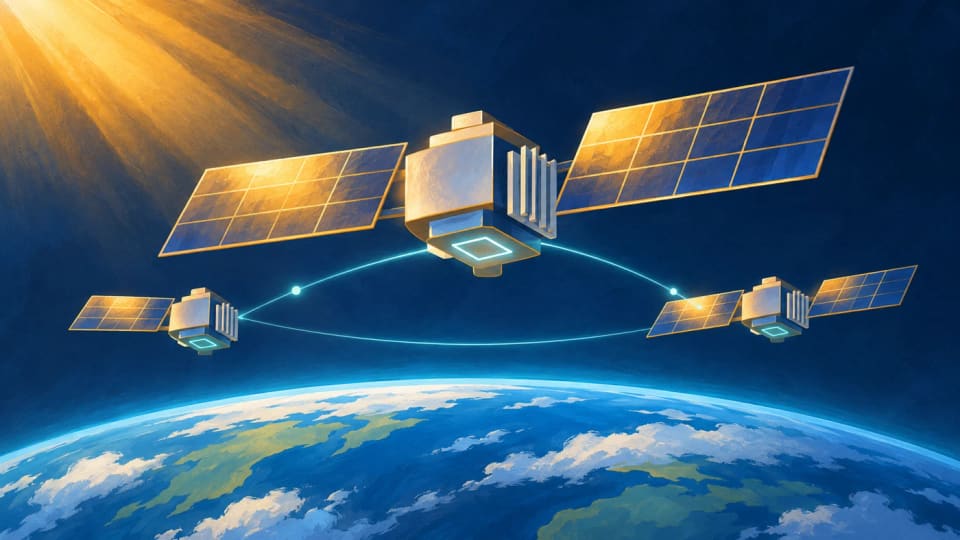
Google announced a Blue Origin partnership for Project Suncatcher's first heavy-lift launch on November 19, 2026. Its announcement targets the first quarter of 2029 for New Glenn to deploy AI-infrastructure satellites into sun-synchronous orbit, extending a research program rather than launching a commercial computing service today.
What is planned for the New Glenn mission?
Google says each satellite would have roughly the computing capacity of a data center rack. The dedicated launch is part of a longer roadmap involving other satellite and launch partners. The brief does not state a satellite count, total cluster capacity, mission price or customer availability.
The target date is a planned milestone, not evidence that the hardware has already flown. Readers evaluating the announcement should keep launch scheduling, successful operation in orbit and a usable service as separate stages.
Why is Google investigating AI infrastructure in space?
Google's September 24 background article describes Project Suncatcher as a long-term experiment in using abundant orbital sunlight for machine learning infrastructure. It explains an earlier prototype effort with Planet intended to study how Tensor Processing Units handle launch stress, radiation and thermal conditions.
That earlier article is background for the engineering questions. Its near-term launch language belongs to September; it does not establish the outcome of that test in November. The new Blue Origin announcement does not supply those results either.
What still has to work in orbit?
The background identifies cooling as a central challenge because a vacuum provides no airflow. Google describes heat pipes and radiators, along with ground testing in a thermal vacuum chamber. It also discusses high-bandwidth laser links between satellites moving in a cluster.
Franklin analysis: a launch agreement makes the next transport milestone concrete, but says little about the economics or reliability of the full system. The useful next evidence would connect hardware survival, sustained workloads, cooling and communications in an integrated orbital demonstration. Until then, rack-scale capacity remains a planned design description rather than a measured production service.
