
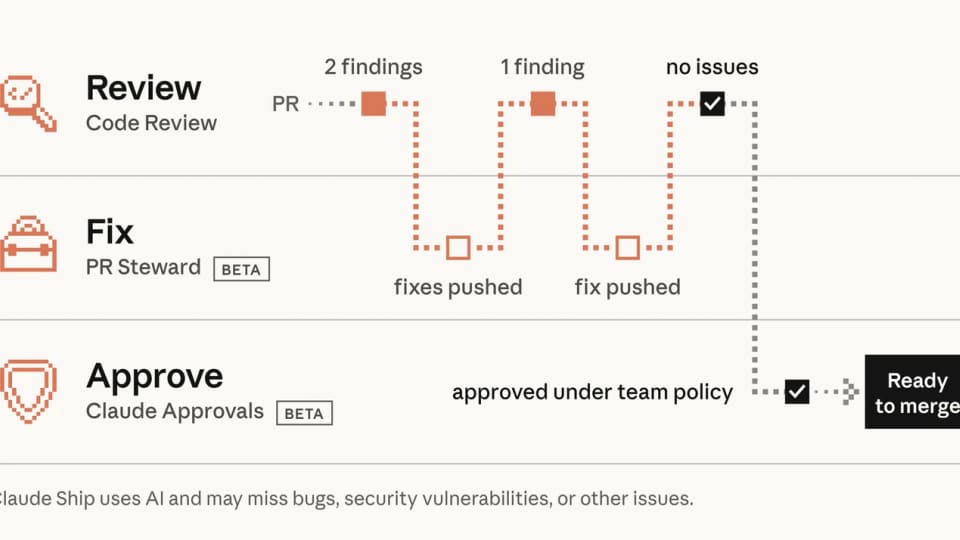
Anthropic introduced Claude Ship on November 23, 2026, to take GitHub pull requests through review, fixes and policy-based approval decisions. The company says the beta is available on Claude Team and Enterprise plans, with repositories and permissions chosen by the organisation.
What does Claude Ship add?
The announcement combines the generally available Code Review service with two beta components: PR Steward and Claude Approvals. Code Review posts findings after examining a change; PR Steward works on failing checks, conflicts and feedback; Claude Approvals evaluates whether the repository's approval policy permits a change to proceed.
Anthropic explicitly says PR Steward is not designed to approve or merge pull requests. Its job is to keep the change ready for the approval process, with comments describing what changed and how to undo it. That distinction separates fixing a problem from deciding whether the resulting code meets a team's policy.
How do teams control approval?
Claude Approvals reads a policy file in the repository. The company recommends starting in observe-only mode before requiring its approval through branch protection. Existing required checks and branch rules still apply, and administrators decide which repositories run each component.
Franklin also covers AOSplane, which organises specifications, reviews and test evidence around agent pull requests. The relationship is the review workflow, rather than proof that the products have identical approval behaviour.
What are the access and cost limits?
Developers can use the new /ship command in Claude Code for their own pull requests as it rolls out. Repository-wide automation is configured by administrators. Claude Ship usage is billed on tokens, with cost affected by the number and size of changes, review depth, frequency and PR Steward's work.
Claude Approvals has no base charge, but model-based classifiers and triggered Code Review can still incur usage charges, including in observe mode. The announcement excludes organisations using Zero Data Retention, the HIPAA configuration or customer-managed encryption keys.
What should a team evaluate first?
The announcement describes a configurable workflow, rather than establishing that autonomous approval suits every repository. Franklin analysis: begin with one repository, a narrow approval policy and retained human review for consequential changes. Inspect the findings, fixes and spending together before expanding the scope; the announcement's internal team experience is not a guarantee for another codebase.
