
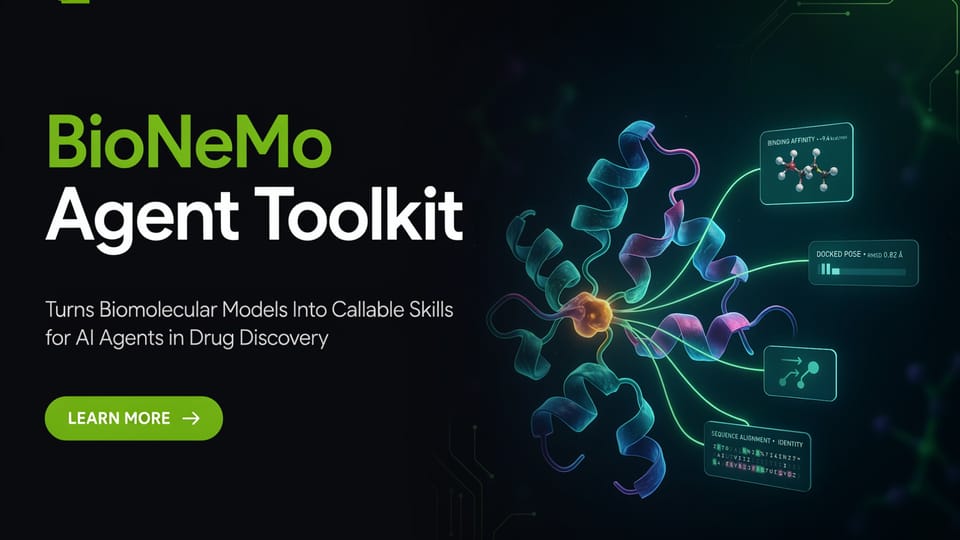
NVIDIA has introduced the BioNeMo Agent Toolkit, a new open-source repository designed to bridge the gap between general-purpose AI agents and the specialized requirements of biomolecular research. By packaging complex biomolecular models as documented, callable skills, the toolkit enables AI agents to reliably perform tasks such as protein folding, molecular docking, generative chemistry, and genomics analysis. This integration transforms NVIDIA’s biomolecular models into tools that agents can discover, select, and invoke with precision. The original reporting from marktechpost.com provides the source detail behind this update.
Enhancing Agent Performance and Reliability
In the context of scientific discovery, general coding agents often struggle to navigate the iterative and uncertain nature of research. NVIDIA’s internal testing demonstrates that providing agents with structured skills significantly improves their efficacy. When using the BioNeMo Agent Toolkit, task completion rates for AI agents increased from 57.1% to 100%. Furthermore, agents demonstrated a 2x increase in passing assertions per 1,000 tokens, indicating a higher level of accuracy and efficiency when executing scientific workflows. The toolkit functions by providing each skill with a dedicated directory containing a SKILL.md file. This file includes instructions, parameters, and failure modes, allowing the agent to read the documentation and act accordingly. By standardizing these interfaces, the toolkit ensures that agents can handle multi-step meta-skills, such as the generative protein binder design workflow, which chains together RFdiffusion, ProteinMPNN, and OpenFold3 models. The same AI Agents question is explored in Recursive Experiential-Working Memory Evolution for Long-Horizon..., which adds a research perspective.
Flexible Deployment and Integration
The BioNeMo Agent Toolkit is designed to support various deployment needs, allowing researchers to choose between hosted and local infrastructure. Users can leverage hosted NVIDIA Inference Microservices (NIM) endpoints for rapid access and testing. For scenarios requiring lower warm latency, data locality, or repeated iteration, models can be deployed locally. The toolkit also includes Model Context Protocol (MCP) server wrappers to expose open models that are not yet packaged as NIMs. Installation is managed through an open-source skills CLI, which allows users to browse and add skills interactively or integrate specific models directly into an agent runtime like Claude or Codex. While the toolkit provides a robust framework for scientific computing, NVIDIA notes that hosted endpoints are intended for small-scale development rather than production-grade inference. Additionally, the company emphasizes the importance of human validation, advising researchers to verify low-confidence structures and filter generated molecules before proceeding with downstream work. By providing a standardized way for agents to interact with models like Boltz-2, DiffDock, GenMol, and Evo 2, the BioNeMo Agent Toolkit aims to make AI a more effective partner in the laboratory. This approach allows scientists to focus on hypothesis generation while the agent handles the technical execution of complex biomolecular tasks. The same AI Agents question is explored in Logos, which adds a research perspective.