
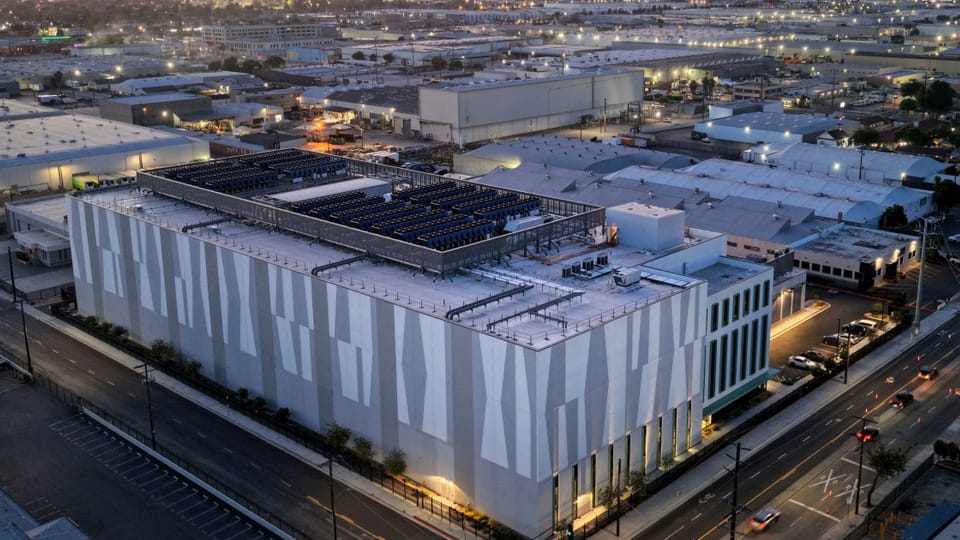
House passes bill to shield consumers from data center price hikes on energy
The House voted 417-3 on Sept. 16 to advance a bipartisan bill designed to keep households, farmers, seniors and small businesses from paying for the costly power infrastructure needed by new artificial intelligence data centers. as reported by Nbcnews The Ratepayers Protection Act would push technology companies and data center operators—not ordinary utility customers—to cover the costs associated with supplying these facilities with electricity. The measure passed under a fast-track procedure requiring support from two-thirds of voting lawmakers.
Its overwhelming approval reflects the growing political pressure surrounding data centers, which provide the computing power and storage used by AI systems. The facilities have become a major campaign issue ahead of the November midterm elections, as voters in swing districts and states object to what they see as rapid development in their communities.
What the House bill would change
Large data centers can require new power generation, transmission lines and other infrastructure upgrades. Under the bill, the federal government would establish a standard for state utility regulators to consider when creating rules for large, high-power data centers.
The goal is to make data center companies responsible for those additional costs rather than leaving them to be recovered from the broader pool of utility customers. Rep. Gabe Evans, R-Colo., who co-sponsored the legislation with Rep. Kathy Castor, D-Fla., said the bill would ensure that families do not subsidize the energy demands of private technology facilities. The policy regulation story also surfaces in Judge rules Pentagon’s supply-chain risk label..., adding another angle.
“America needs the infrastructure to lead the world in AI and outcompete Communist China, but we cannot have that growth at the expense of hardworking families, farmers, seniors, and small businesses,” Evans said in a statement after the vote. as reported by Nbcnews The measure does not prohibit data centers or determine where they can be built. It also does not address broader concerns raised by former AI employees and researchers about the potential dangers of rapidly advancing AI systems, including warnings that the technology could cause human extinction.
Why data centers have become a campaign issue
President Donald Trump has supported construction of new data centers, arguing that they are critical for U.S.-based AI companies competing with China. But the expansion has met resistance from voters who say the facilities are being built too quickly and could place unwanted demands on local communities and energy systems.
A recent NBC News Decision Desk Poll powered by SurveyMonkey found that nearly 70% of adults oppose building AI data centers in their neighborhoods. Forty-five percent said they were strongly opposed.
The opposition has put pressure on lawmakers, particularly Republicans facing competitive races. Evans, a first-term representative, is running against Democratic state Rep. Manny Rutinel in a race the Cook Political Report has characterized as a “toss-up.” Evans and other at-risk lawmakers had pushed Republican leaders to hold a vote on data centers before the midterm elections. The same ai search question is explored in ActMap, which adds a research perspective.
The House also considered several energy-related bills during its final week in session before the Nov. 3 elections. Those votes came as oil remained above $100 a barrel and inflation and the high cost of living ranked among voters’ top concerns.
Democrats called the measure a minimum step
Although progressive Reps. Summer Lee, D-Pa.; Delia Ramirez, D-Ill.; and Rashida Tlaib, D-Mich., were the only lawmakers to vote against the bill, several Democrats who supported it said it did not go far enough.
Rep. Veronica Escobar, D-Texas, said communities were “understandably very angry that Congress isn’t doing enough” about data centers. She described her vote as support for “the bare minimum,” adding that her constituents do not want data centers in their community.
Rep. Debbie Dingell, D-Mich., also voted for the bill while saying it was “not enough in any way, shape or form.”
Tlaib argued that Congress should instead impose a national moratorium on data centers and prohibit them on federal lands. She said the bill “fails to meaningfully protect our communities.” The ai industry story also surfaces in Meta to Build 50 Billion Dollar..., adding another angle.
Former Progressive Caucus Chair Pramila Jayapal, D-Wash., supported the measure but warned against treating it as a complete response to the AI debate. She pointed to Trump’s comments that the AI industry does not need guardrails and that serious safety warnings about AI are a “hoax,” saying those remarks conflict with efforts to create meaningful regulation.
What happens next
The bill now faces an uncertain path in the Senate, which has its own data center legislation but has not advanced any of it. With the House having completed its final votes before the midterm elections and the Senate scheduled to remain in Washington for only a few more weeks, significant action on AI policy may not come until the postelection lame-duck session.
That leaves several unresolved questions. The House measure sets a federal standard for state utility regulators, but the source material does not specify how those regulators would apply it or how costs would be divided in particular projects. It also does not address whether communities can block data centers, limit their construction or impose a broader pause on development.
For now, the vote signals that lawmakers from both parties see energy costs as one of the most immediate political fault lines in the AI expansion. The central dispute is no longer only whether the United States should build the infrastructure needed to compete in AI, but who should pay for the electricity and grid upgrades that make that expansion possible.