
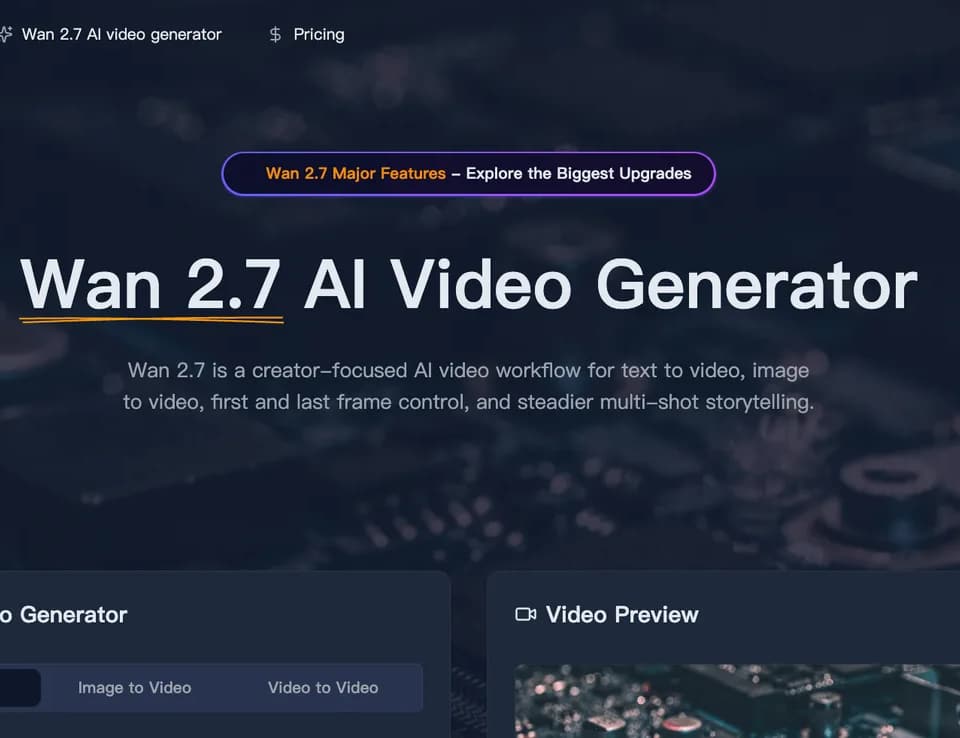
wan27.app
wan27.app presents Wan 2.7 as a creator-focused AI video workflow for generating and refining short video content. It covers text-to-video, image-to-video, reference-led creation, first- and last-frame control, and multi-shot storytelling, alongside showcase examples and paid credit plans.
What it does
Wan 2.7 is designed to turn written scene directions, images, and other reference material into video clips. The documented workflow is to enter a prompt or upload an image or video reference, choose settings such as duration, aspect ratio, and output quality, then generate and download the result. The site positions the workflow for ads, storyboards, social content, product demonstrations, portraits, action scenes, and other short-form creative work.
Notable capabilities
- Text-to-video: Prompt-led scene creation with descriptions of subjects, movement, lighting, camera behavior, and style.
- Image-to-video and reference workflows: Uploaded images, videos, and 9-grid references can provide guidance for composition, styling, subject appearance, and motion.
- First- and last-frame control: Start and end frames can be used to guide openings, endings, and transitions.
- Instruction-based editing: The site describes instruction-based editing and recreation controls as ways to revise generated clips more directly.
- Output and motion controls: Plans list motion control, adjustable duration and aspect ratio, and output options advertised up to 4K resolution.
Who it helps
The workflow is presented for marketers, filmmakers, designers, social-media teams, e-commerce operators, educators, and other creators who need reviewable video drafts. Reference controls may be useful when a product, character, outfit, or visual style needs to remain recognizable across a clip or short sequence. The showcase also includes examples for fashion, fantasy, anime, nature, science fiction, product stories, and multi-shot action.
How it fits a workflow
A practical use case is moving from a creative brief or approved visual to a short draft for review. A creator can establish the intended subject and scene with text or references, set the delivery format, and use start/end guidance when timing or transitions matter. The site describes the workflow as supporting faster prompt iteration, pre-visualization, storyboard approval, and short-form campaign production. It also discusses audio-aware timing, although the supplied material does not specify an audio-generation or editing interface.
Strengths and limits
The main strengths described by the site are reference-driven control, first- and last-frame guidance, multi-shot continuity, and an editing-oriented revision process rather than only one-pass generation. These are presented as improvements in the Wan 2.7 workflow compared with Wan 2.6, not as independently measured benchmarks.
Access is credit-based on the published pricing page. Listed annual-billing options include Starter at $9.90 per month with 9,600 credits per year, Premium at $19.90 per month with 24,000 credits, and Advanced at $49.90 per month with 72,000 credits. The plans advertise commercial-use licensing, no-watermark generation, privacy protection, and up to 4K output; queue priority and support differ by tier. Generation costs vary by model, duration, and settings, and subscription credits reset each billing cycle while one-time credits do not expire.