
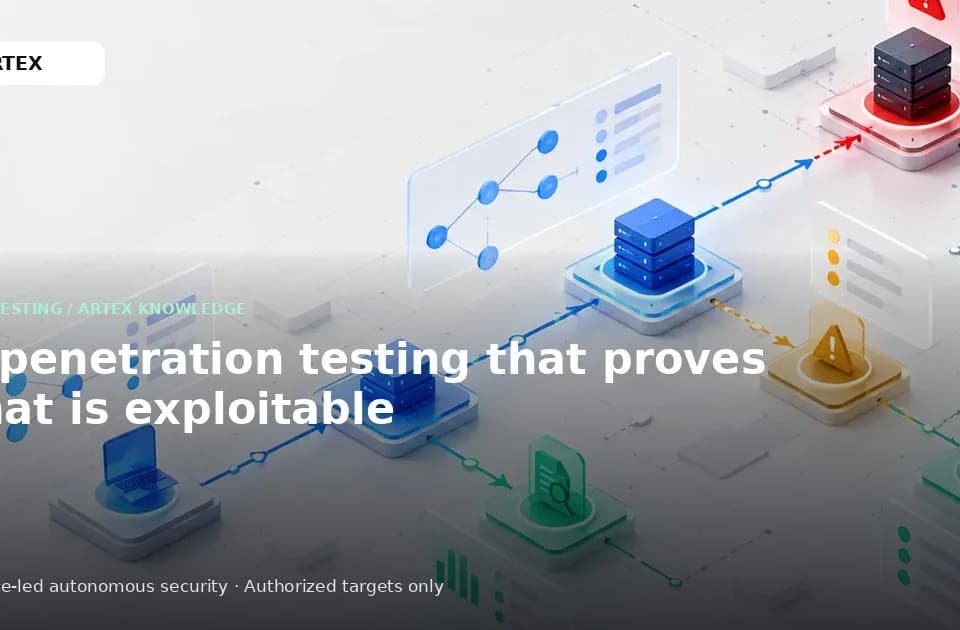
ARTEX: an AI security testing and evidence console
ARTEX coordinates authorized security-agent tasks and keeps findings, traffic, command logs and approval records together for review.
ARTEX is a console for coordinating AI security agents against systems the operator owns or is authorized to test. Its official documentation describes a planner, parallel workers and a shared record of findings, traffic, commands and approvals.
What does the ARTEX workspace contain?
The product organizes testing as tasks connected to assets and observed activity. The planner maintains objectives while workers explore the authorized scope and record evidence. Human approval is available for sensitive actions.
The documentation emphasizes reproduction evidence rather than treating a generated vulnerability narrative as a confirmed finding. Requests, responses, command output and relevant preconditions should stay attached to the result so another engineer can inspect what happened. That makes the evidence review workflow as important as scheduling an agent run.
What controls and requirements are documented?
ARTEX describes traffic recording, command visibility, interception rules and approval records. Its guidance says testing requires owned systems or explicit written authorization, along with defined scope and exclusions. Those controls are described by the publisher; they do not establish that an agent is safe to run against an arbitrary production system.
The site recommends starting in an isolated lab or tightly scoped staging environment. Human security owners still set the scope, review the impact of findings and approve sensitive actions. The documentation does not present AI agents as a blanket replacement for manual testers or deterministic scanners.
How is ARTEX available?
The publisher describes hosted plans and a self-hosting route through a single binary or Docker Compose stack. The captured pricing page lists Starter at $29 a month with one concurrent task run and five targets. Pro is $79 a month with three concurrent runs and 25 targets, plus continuous monitoring and additional controls.
What should teams evaluate first?
The service terms state that completion times and specific findings are not guaranteed. Franklin analysis: a useful evaluation should check whether a permitted test produces a coherent evidence trail, how a blocked action appears and how a finding is retested after remediation. An autonomous run finishing is not itself proof of complete coverage or a verified security conclusion.
Before you try it
Frequently asked questions
Does ARTEX require authorization for the target?
Yes. The official guidance limits use to systems the operator owns or has explicit written authorization to test, with scope and exclusions defined before execution.
Official sourceWhat evidence should an ARTEX finding retain?
The documentation describes keeping the affected asset, request and response, command output, reproduction preconditions and retest status with the finding.
Official sourceCan ARTEX be self-hosted?
The official guide describes self-hosting as a single binary or Docker Compose stack. Teams still need to review the current source, deployment requirements and authorization boundaries.
Official sourceAre run completion times or findings guaranteed?
No. The captured service terms state that task runs depend on capacity and do not guarantee completion times or specific findings.
Official source