
Abracadabra for investigating what users need from an AI agent
Abracadabra investigates user needs and failures in agent conversations. Its task funnels and cohort comparisons link back to the conversation evidence.
Abracadabra analyzes conversations to show what people ask an agent to accomplish and where the interaction breaks down. The official site presents it as product analytics for understanding user tasks, with each finding linked to the conversation behind it.
What does a conversation investigation show?
The product groups differently worded requests into topics and tasks, then identifies intentions and signals such as confusion, unresolved requests or repeated questions. A team can move from a pattern across conversations to the original turns in session replay.
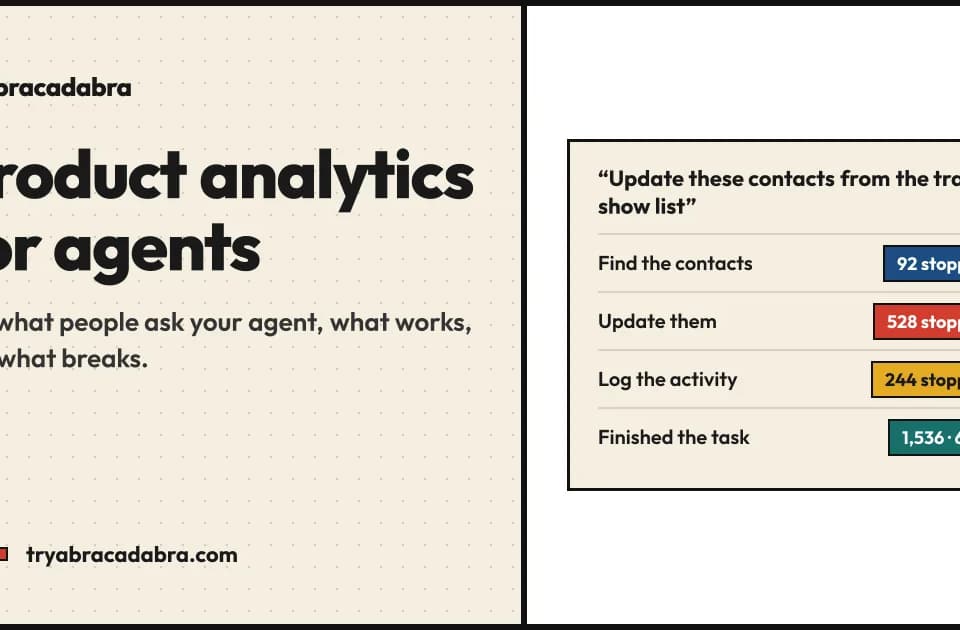
Its demonstration follows a contact-update task through finding contacts, updating them and logging the activity. The interface shows where attempts stop and lets a reviewer inspect the affected conversations. These are illustrative product examples; the website’s counts and completion percentages are not evidence of a measured improvement for a customer.
How do task funnels and cohorts help?
A task funnel makes it possible to ask which step repeatedly loses users. Cohort comparisons separate groups such as plans, regions or returning users, helping a team decide which conversations need closer inspection.
The site distinguishes this user-experience view from traces and evals, which describe how an agent runs. Conversation evidence can show what the person wanted and whether the interaction left that request unresolved. A funnel or summary remains a starting point for investigation, rather than a substitute for reviewing the underlying conversation.
How does a team start using Abracadabra?
The captured access route is to request a workspace by work email. The publisher says it emails access and that its free plan does not require a card. An open playground demonstrates the workflow; the captured source does not specify paid-tier prices or production ingestion limits.
Franklin analysis: begin with a recurring user task and inspect several conversations behind the reported failure step. Confirm whether a skipped action reflects missing information, a legitimate restriction or an agent mistake before changing the product. The same completion percentage can conceal very different causes, and the site’s illustrative data should not become a benchmark for a real deployment.
Before you try it
Frequently asked questions
Does Abracadabra’s demonstration show customer performance?
The site labels its funnel counts and cohort percentages illustrative data. They demonstrate investigation controls rather than a verified customer result.
Official sourceCan a reviewer inspect the evidence behind a finding?
The publisher says findings link to the words behind them and affected conversations can be opened in session replay to review what happened.
Official sourceWhat can a team compare between user groups?
The product describes comparisons by plan, region and returning-user status, followed by inspection of the conversations in each group.
Official source