
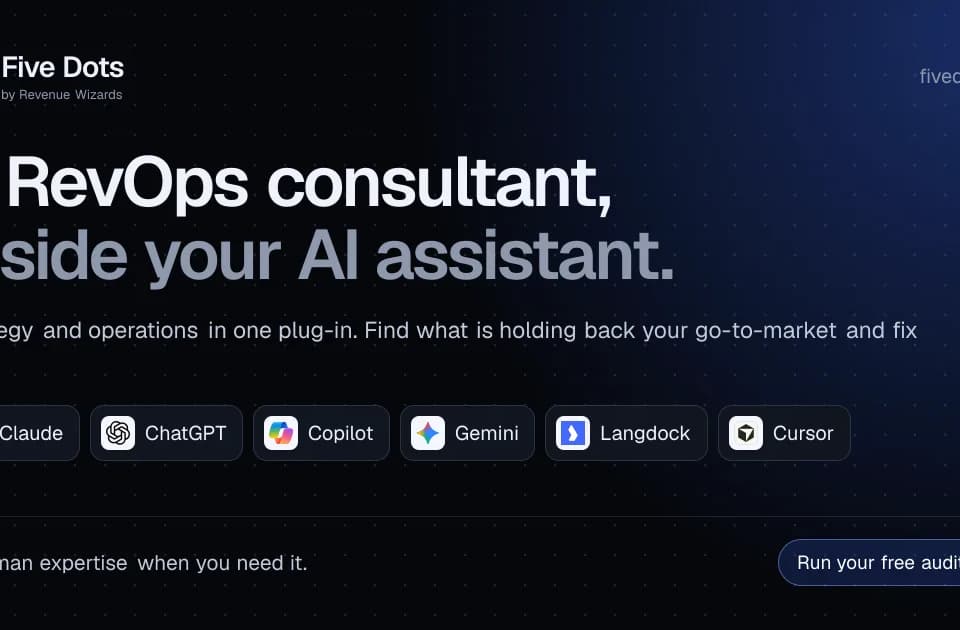
Five Dots for revenue-operations audits inside an AI assistant
Five Dots gives an existing assistant revenue-operations checks and playbooks. Its free audit produces a roadmap, while paid plans add fix instructions and expert support.
Five Dots supplies revenue-operations checks, playbooks and skills to an existing AI assistant. Its official site describes a workflow that audits a go-to-market system, prioritizes gaps and helps the assistant implement approved fixes through the user’s connected tools.
What does a revenue audit examine?
The audit starts with who the business sells to, then considers pipeline, data quality, renewals and reporting. Outputs include an area-by-area scorecard, a ranked roadmap with effort and owners, and a one-page readout.
The publisher says Five Dots sends the method rather than receiving CRM records, findings or reports. The assistant reads connected systems under the user’s existing permissions. Information is still processed by the chosen AI provider and connected tools under their own agreements; the publisher’s data-flow description does not make the entire workflow local.
How are recommendations turned into changes?
The connection uses MCP and the customer’s own assistant subscription. Each fix starts with a plan showing before and after, and the publisher says changes require approval. The assistant then makes one change, reads it back and records it with an undo method in a Changes register.
The site recommends testing in a sandbox before production. It also describes standing checks that run from the assistant’s scheduler or when requested, rather than Five Dots independently operating between sessions.
What is free and what is separately paid?
The free audit has no card requirement or time limit. Core adds instructions for all roadmap fixes, broader playbooks, an onboarding hour and monthly expert credits. Managed is a scoped service in which the team operates inside the customer’s systems.
Expert credits buy human conversation time, not AI tokens or hands-on implementation. The source says one credit equals one minute; hands-on work is separately agreed as a project. The customer’s AI subscription remains an additional requirement.
The site reports an artificial test-company audit with planted problems. Franklin analysis: use the audit to organize evidence and proposed changes, but verify findings against actual records. That vendor experiment does not establish a guaranteed increase in revenue or a universal error-detection rate.
Before you try it
Frequently asked questions
Does Five Dots require an existing AI subscription?
Yes. The publisher says the user’s own AI subscription is required. Five Dots supplies its method while that assistant performs the AI work.
Official sourceDo expert credits pay for CRM implementation work?
No. One credit buys a minute of conversation with an expert. Hands-on work inside a system is a separately scoped project or day-rate engagement.
Official sourceDoes Five Dots keep monitoring systems by itself?
The publisher says it runs nothing between sessions. Standing checks run from the assistant’s scheduler, a recurring task or an explicit user request.
Official source