
DeerFlow
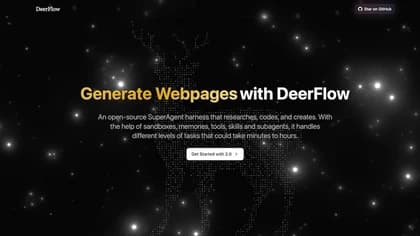
DeerFlow is an open-source SuperAgent harness for research, coding, and content creation. The official DeerFlow website describes it as a LangChain-based framework that combines sandboxes, memories, tools, skills, and subagents for tasks that may run from minutes to hours.
What it does
DeerFlow is designed to coordinate multi-step AI work rather than handle only a single prompt. Its example workflows include deep research, dataset exploration, webpage creation, video and reference-image generation, podcast collection and summarization, and analysis of technical topics. The system can plan ahead, break complex work into subtasks, and execute those subtasks sequentially or in parallel, according to the publisher.
Notable capabilities
- Deep research workflows: Searches and organizes information into reports, including examples involving technical founders, podcasts, and agent technology trends.
- Coding and execution: Uses a persistent sandbox with a file system so the agent can write, read, and run files. The site also shows a Pygame installation and execution example.
- Memory and context: Supports long- and short-term memory to help the agent retain and use context across work.
- Extensible tools and skills: Built-in tools and skills can be plugged in, replaced, or customized; the site shows skills for areas such as deep search, frontend design, deployment, and scientific domains.
- Multiple model options: The publisher lists support for models from Doubao, DeepSeek, OpenAI, Gemini, and other providers.
Who it helps
DeerFlow is aimed at developers and technical teams building self-hosted AI agents or SuperAgent workflows. It may fit researchers, analysts, and engineers who need an agent to combine browsing or research, code execution, file handling, planning, and generated outputs in one process. Its open-source MIT license and self-hosted positioning may also suit teams that want control over their deployment and agent configuration.
How it fits a workflow
A typical workflow can start with a natural-language task, then use planning and subagents to divide the work. The agent can call tools and skills, operate inside an isolated sandbox, preserve files on a persistent mount, and return a report, analysis, webpage, or other generated artifact. DeerFlow recommends an All-in-One Sandbox that combines Browser, Shell, File, MCP, and VSCode Server in one Docker container.
Strengths and limits
Its main strengths are the combination of long-running task support, planning, persistent file-based execution, memory, and extensibility in an open-source framework. The website demonstrates broad task types, but those examples should not be treated as performance benchmarks. Teams evaluating DeerFlow should verify the setup requirements, available model and tool configurations, sandbox isolation, and the skills needed for their particular workflow.