
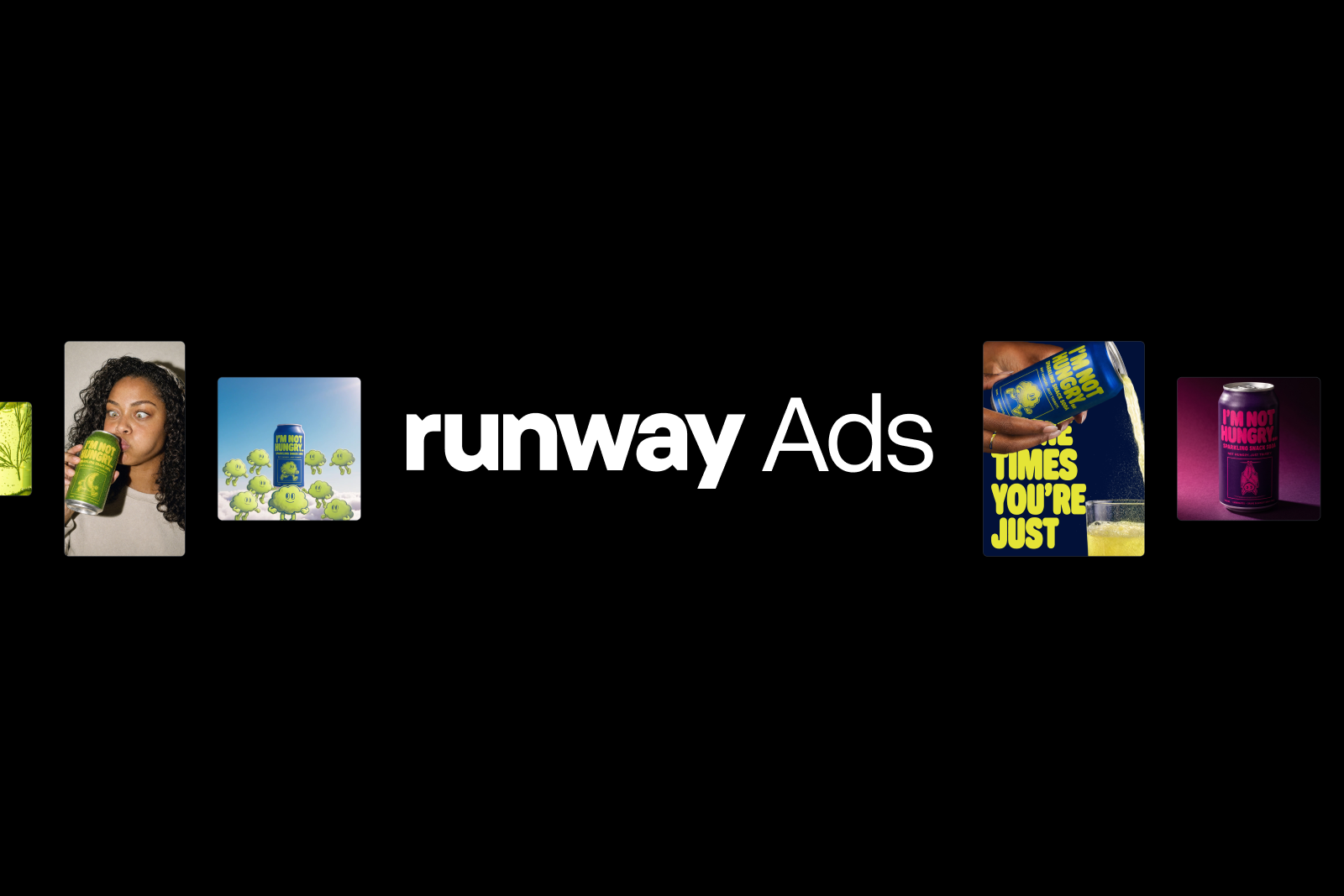
Runway has announced Runway Ads, a product intended to connect ad generation, publishing and performance feedback in one system. Its September 30 announcement describes generating video and image variants from a brand kit, sending approved versions to Meta, Google and TikTok, then using platform results to produce the next batch.
The access statement is narrower than the list of advertised use cases. Runway says it is piloting the product with select enterprise partners and invites prospective customers to contact its sales team. The page describes what small businesses and individual creators could do with the system, but it does not establish a general self-serve launch or publish a subscription price.
Creative production continues after an ad is published
Runway Ads uses brand guidelines, previous ads and product imagery as inputs. The proposed loop includes generating variants, resizing them for channel specifications and retrieving performance data from the platforms where they run.
Runway says the system then develops new creative around combinations that earned spend. That connects creative decisions with the advertising account's observed activity. It does not establish that the highest-spend variant necessarily delivers the best profit or that a successful pattern will continue to work without review.
The scope extends beyond making a standalone video. For comparison, Franklin AI's AdsGenie overview explains a template-led starting point for product ads. Runway's announcement describes adding connected publishing and performance-driven regeneration to the creative workflow. These are different described scopes, rather than an independent head-to-head product test.
Human approval starts enabled
Runway says it runs every variant through an automated brand check before sending it to an approval queue. Human approval is enabled by default. Teams can opt into automated publishing for a campaign or a type of variant as they gain confidence.
That choice makes the review policy part of a deployment decision. A team considering the pilot should establish which changes require a person to approve them and which variations it is prepared to publish automatically. The presence of a brand check does not itself prove that every generated product claim or visual detail will be correct.
The announcement also describes respecting team-defined budget limits, including maximum daily changes, minimum shares of new audiences and retargeting caps. These are configurable boundaries in the described system. The page does not provide their complete implementation details, so the product claim should not become an assurance that a particular account can run unattended without a budget review.
Localization includes text and product screens
Runway says localization adapts on-screen text and product screenshots as well as voiceovers. Teams can set rules for brand voice and terms that should remain untranslated. The system also reformats creative for aspect ratios and channel requirements.
Its examples include a mobile app bringing a winning ad into other markets, an ecommerce brand creating assets from product feeds and an agency managing multiple client accounts. The announcement says market-level analysis can treat each localized campaign separately because a winning hook may not transfer between places.
These are intended workflows, not case studies demonstrating the same outcome for each customer. Localization still needs an acceptance check for the actual language, product interface and offer. The source describes automation and rules but supplies no independently measured accuracy rate for translated screens or generated product depictions.
Runway's own results are company-reported
Runway says it built the product on infrastructure used for its own performance marketing, especially on Meta and TikTok. Since July, the company reports increasing weekly ad volume from 77 to roughly 900 while doubling return on ad spend. It also reports conversion up about 34%, a steady click-through rate and a 41% reduction in cost per subscriber.
Those figures describe Runway's account of its own program. The announcement does not provide a controlled comparison, complete spending history or a result distribution for the enterprise pilot. The figures therefore cannot establish the improvement another advertiser should expect or isolate which part of the system caused the change.
Runway Ads is a proposal to manage a repeated creative-and-measurement cycle with human controls. Its current pilot status, approval settings and actual connection to an advertiser's goals are more useful evaluation points than assuming the company's internal gains will repeat elsewhere.