
Documentation.AI
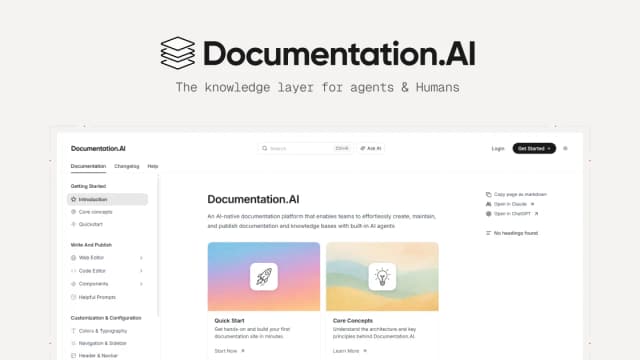
Documentation.AI maintains product and API documentation with an agent that drafts updates for human approval. Teams can edit in a browser or through Git and MDX, collaborate on branches and review changes before publishing.
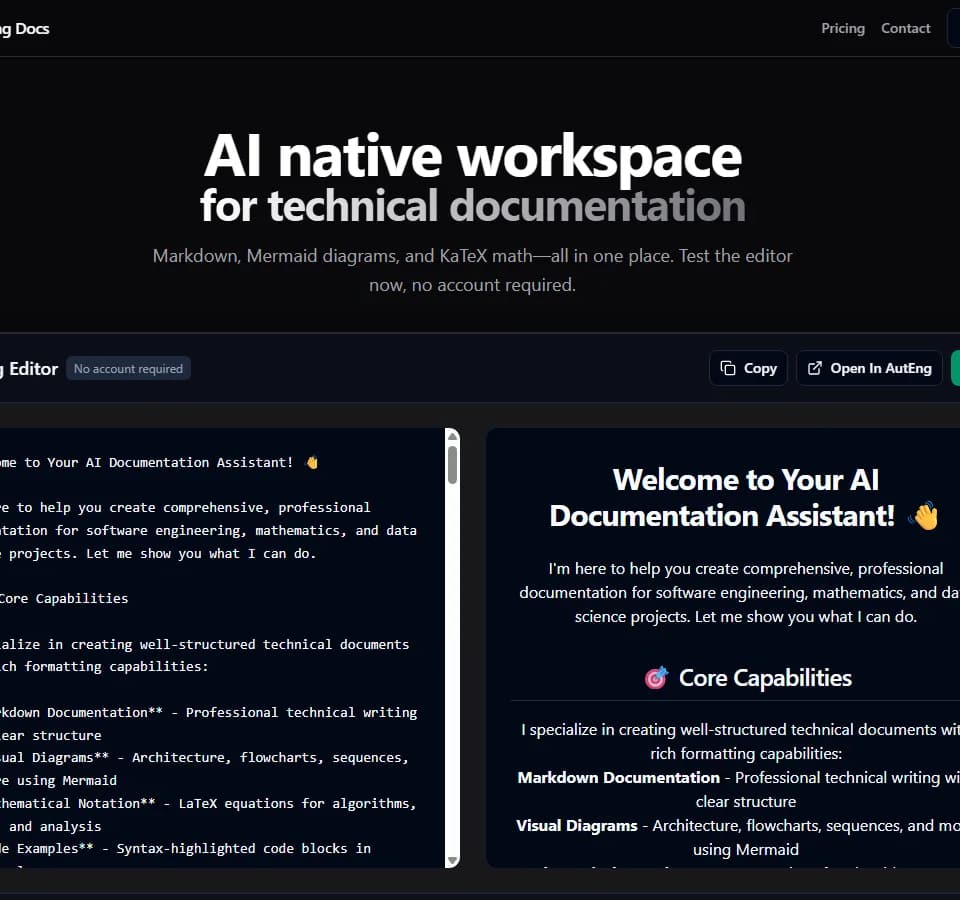
AutEng combines technical-document editing with AI drafting, Mermaid diagrams, KaTeX mathematics, and explicit mathematical verification workflows.
AutEng is an AI-assisted workspace for technical documentation. The official overview combines GitHub Flavored Markdown, Mermaid diagrams, KaTeX mathematics, and code examples in one editor. The documented use cases include architecture documents, API specifications, algorithm explanations, runbooks, and tutorials.
The homepage offers an editor without requiring an account. Creating an account is described as the next step for saving work and generating public share links. A public share link is a distribution feature, so review a document for private project information before using it.
AI generation is advertised for drafting documents and diagrams from a technical request. A rendered diagram or well-formatted explanation still needs to match the actual architecture, API, or algorithm being documented.
AutEng distinguishes symbolic checks using SymPy from formal proof verification with Lean 4 and Mathlib. Its verification guide points to examples of both approaches. These are explicit checks on mathematical content, not a blanket guarantee that every generated technical document is correct.
The quadratic-formula tutorial explains the difference between expression equivalence and solution-set equivalence. It describes using solve mode to detect steps that lose or introduce solutions, with statuses for equivalent, narrowed, widened, unknown, or failed results.
The captured examples display a Not Verified state alongside expected outcomes and a Verify control. They should not be presented as results this review has executed. The selected domain, assumptions, and expression supplied to a checker matter; a verification result also does not establish that a mathematical model describes a real system correctly.
The captured pricing page describes monthly chat quotas, a Solo plan, and bring-your-own provider keys. It says provider-key usage is billed directly by the provider, rather than making the underlying inference free.
Some plan content remains incomplete or contradictory: the page is loading plan cards, and its free-plan chat statement differs from a later statement about no AI after cancellation. Verify the actual account entitlement before assuming a free AI allowance. The Team offering is explicitly marked coming soon, so its shared-workspace features are not described here as generally available.
For evaluation, edit a small non-sensitive Markdown document, inspect its rendered diagram or equation, and run the relevant verification operation when mathematical correctness is the task. This overview establishes the documented tools and distinctions, not hands-on proof execution or universal correctness.
Before you try it
The workspace combines Markdown, Mermaid diagrams and KaTeX mathematical notation. It is aimed at technical documents such as architecture notes, ADRs, API specifications and runbooks.
Official sourceIts verification guide distinguishes chain mode, which compares algebraic expressions, from solve mode, which compares solution sets. Use the appropriate mode and explicit assumptions when checking a derivation; a displayed example still needs its Verify action to run.
Official sourceThe published pricing FAQ conflicts: one answer lists two free chats each month, while another says the free plan has no AI after cancellation. Confirm the current account allowance before depending on free AI access; the editor itself is offered without an account.
Official sourceDocumentation.AI maintains product and API documentation with an agent that drafts updates for human approval. Teams can edit in a browser or through Git and MDX, collaborate on branches and review changes before publishing.

CypherScribe turns supplied material into customizable documentation sites with an editor, search, and an advertised document-trained AI bot.

Wan 2.6 generates short AI videos and images from text, images, video references, and audio with advertised 1080p output and synchronized sound.

Independent overview of Kirkify AI for face-swap memes, including its workflow, verified access details, limitations, and official website.
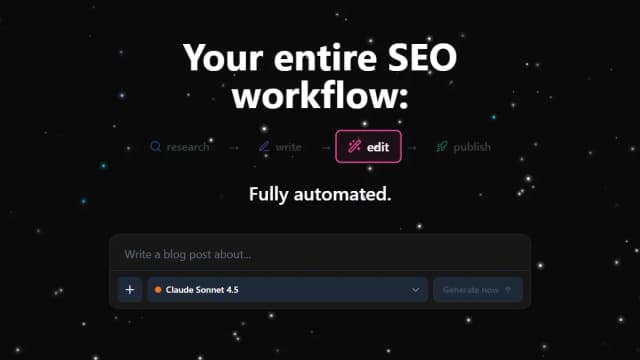
AI SEO Blog Writer is Agentive SEO’s advertised platform for keyword research, AI article generation, SEO optimization, and publishing. It is currently marked “COMING SOON” and available through a waitlist.

Vibbo is a browser-based AI tool for text transformation and interactive text, image, video, and audio workflows.