
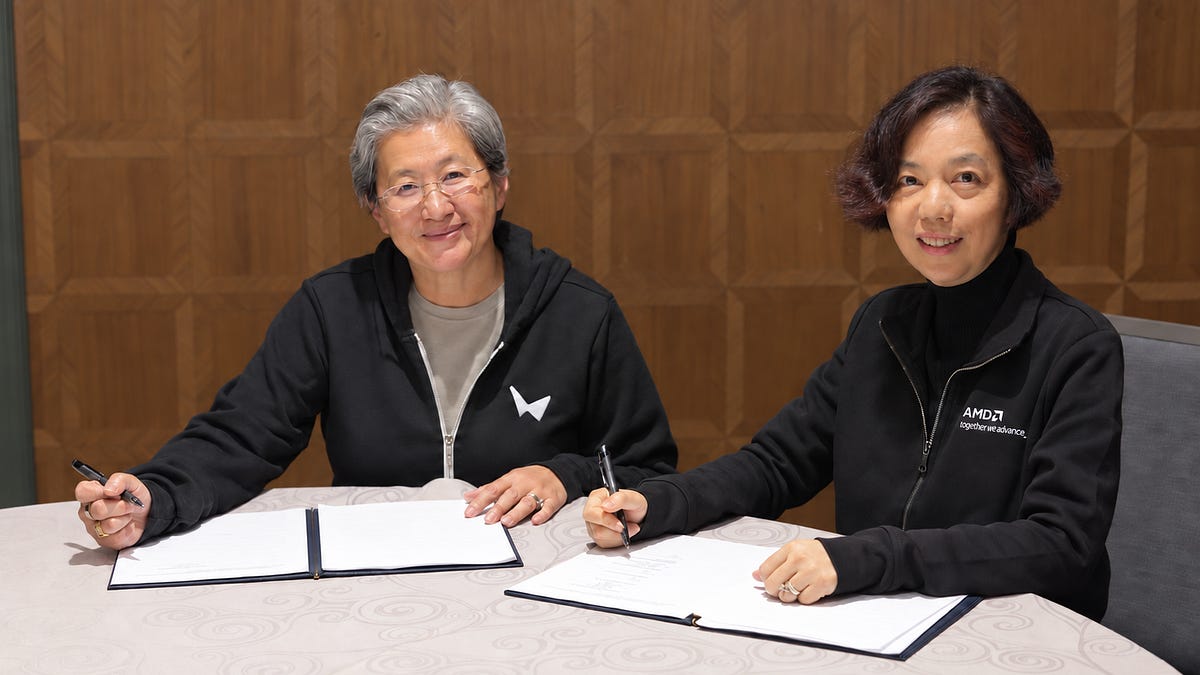
World Labs is joining AMD, according to a September 28 announcement from co-founder Fei-Fei Li. In her account of the move, Li says she will join as an executive vice president and chief scientist, working directly with AMD chief executive Lisa Su and her team.
Li frames the combination around spatial intelligence: models that reason about the structure and behavior of the physical world. Her argument is that applications in science, entertainment, and robotics need models to understand real objects and their relationships, rather than relying on language alone.
From visual intelligence to a spatial-model lab
Li traces that goal back to entering AI as a graduate student in 2000, studying visual intelligence in machines and the brain. She describes ImageNet as part of the work that helped usher in modern AI alongside neural networks and their implementation on GPUs.
Her account connects that research with later work in robotics and healthcare, establishing Google Cloud's AI unit as chief scientist, and becoming founding director of Stanford's Human-Centered AI institute. When large-scale frontier research increasingly moved into industry, she chose a startup as the vehicle for building foundation models beyond language.
She founded World Labs in early 2024 with Ben Mildenhall and Justin Johnson. The team brought together researchers and engineers working across data, computer vision, large-model training, systems, and computer graphics. That mix reflects the lab's focus: reconstructing and generating a physical scene requires more than producing a textual description of it.
What Atlas is intended to predict
The announcement highlights Atlas, which Li describes as a model architecture trained from scratch to predict a new camera view from two-dimensional images. She compares the prediction task with a language model predicting the next token. Here, the expected output concerns another view of a scene, with the geometry that connects the views.
Li says Atlas combines generative modeling with multiview geometry to address sparse reconstruction. She claims strong results compared with specialized models and describes interest in using the work for robotics reinforcement-learning environments, scene generation for therapy and entertainment, and real-world reconstruction for real estate, design, and construction.
World Labs' acquisition of SceniX is also part of the account, connected to building robotics-simulation capabilities. These strands place the company's model work alongside environments where researchers or creators could use reconstructed and generated scenes.
Why the hardware relationship matters
According to Li, AMD has been involved since World Labs' early days, with Su an early investor and supporter. She says a deeper technical partnership began last year around model training and inference optimization on AMD GPUs.
Li argues that accelerating spatial AI requires scaling the research effort, widening its reach, and moving closer to hardware. The joining announcement extends a relationship that already involved technical work, bringing the lab's foundation models and applications into the same organizational setting as that hardware effort.
She describes a continuing frontier research organization within AMD and states a commitment to open models and platforms. The intended scope runs from hardware and software through models to the data platforms needed to support them, with collaboration across the wider ecosystem.
The announcement does not provide transaction terms, an integration timetable, new model licenses, or a full Atlas benchmark protocol. Its performance and application claims remain Li's account, rather than an independent evaluation. The existing GPU collaboration and her stated new role are concrete; the open-stack mission sets the direction for releases and results still to come.