

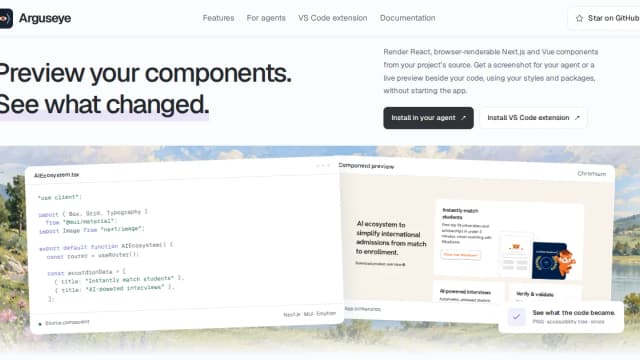
Arguseye: preview real components for coding agents and VS Code
Arguseye renders components with a project’s own dependencies and styles, returning screenshots, accessibility snapshots and explicit context warnings.
Loftsmith turns descriptions and measurements into parametric CAD, with printer-aware geometry checks and options to test a small section before printing the full part.
Loftsmith is a conversational CAD tool for functional 3D-printed parts. You describe a bracket, enclosure or clip, supply dimensions that matter, and adjust the resulting parametric design. Its focus is the fit and geometry of a physical part, including the printer and material you intend to use.
The Loftsmith homepage describes adding a photograph and drawing a line across a measured feature. A measurement gives the design a scale that the picture alone cannot establish. The product then builds parametric CAD that you can change with sliders or by marking a particular area and describing a revision.
For a fan bracket, that means starting with the fan size and mounting constraints rather than asking for a plausible-looking shape. The site lists functional examples such as enclosures, hooks and print-in-place mechanisms. Treat a generated design as a starting point to inspect against the hardware you have, especially around holes, fasteners and mating surfaces.
Loftsmith says it checks designs for overhangs, bed fit and walls that are too thin to print. It also describes slicing each version into layers and displaying the checks and changes. If a snap-fit or screw boss needs testing, you can select that section and print it before committing to the whole object.
The publisher lists STL downloads per part and 3MF export with parts arranged on a plate. You still need your slicer. File export is part of preparation, while your printer settings and physical test determine whether the part works as intended.
Loftsmith's engineering checks are estimates, not strength certification. The company says to print a test piece and load it yourself. The same caution applies to its larger mechanical examples: a calculated check or an attractive render does not establish that a printed assembly is safe under your actual load and print conditions.
The publisher says Loftsmith supports any FDM printer through a profile or a generic bed size, with oversized designs split to fit. Its intended jobs include mounts, jigs and enclosures. Sculptures, figurines and miniatures fall outside the stated focus.
The current Free account includes a first design without a card; paid plans add design capacity, private projects and other capabilities. Slider adjustments run on your computer, according to the publisher, and do not consume design credits. Review the current plan's export formats and commercial-use terms before preparing something for sale. The clearest first project is a small, measurable part with a cheap fit test, so you can evaluate the design against a real object without risking a long print.
Local sliders, checks and downloads are described as free forever; new AI design work uses the account's credit allowance. That distinction matters when comparing the free first design with a paid plan for repeated design work.
Before you try it
Loftsmith says it checks designs for overhangs, bed fit and walls that are too thin to print.
Official sourceThe publisher lists STL downloads per part and 3MF export with parts arranged on a plate.
Official sourceLoftsmith's engineering checks are estimates, not strength certification.
Official sourceArguseye renders components with a project’s own dependencies and styles, returning screenshots, accessibility snapshots and explicit context warnings.

Codequiry combines peer and web comparisons with AI-code detection, showing matched lines and source URLs for educators to review rather than treating a score as a verdict.

TaskyTrack drafts requirements, a data schema and UI direction from a client conversation, then exports the reviewed brief for developers or coding tools.

Jet Admin combines data-connected app building, workflow logic and governance controls, with cloud, self-hosted and on-premise options described by the publisher.

Backplane combines tasks, decisions, dependencies and review records, with MCP connections and experimental runners for Claude Code and Codex CLI.

Swebsy combines templates and visual editing with a local agent bridge, then exports HTML, CSS, JavaScript and assets for hosting elsewhere.