
Home
Home is an open context layer for carrying user-owned AI memory across multiple assistants and applications. It is designed to keep preferences, project knowledge, writing styles, and other context portable instead of tying them to a single AI platform.
What it does
Plurality Network provides infrastructure for storing and applying context across AI tools including ChatGPT, Claude, Gemini, Grok, DeepSeek, and Perplexity. Its AI Context Flow is intended to let users set up their context once and reuse it in different conversations through a browser extension or MCP server.
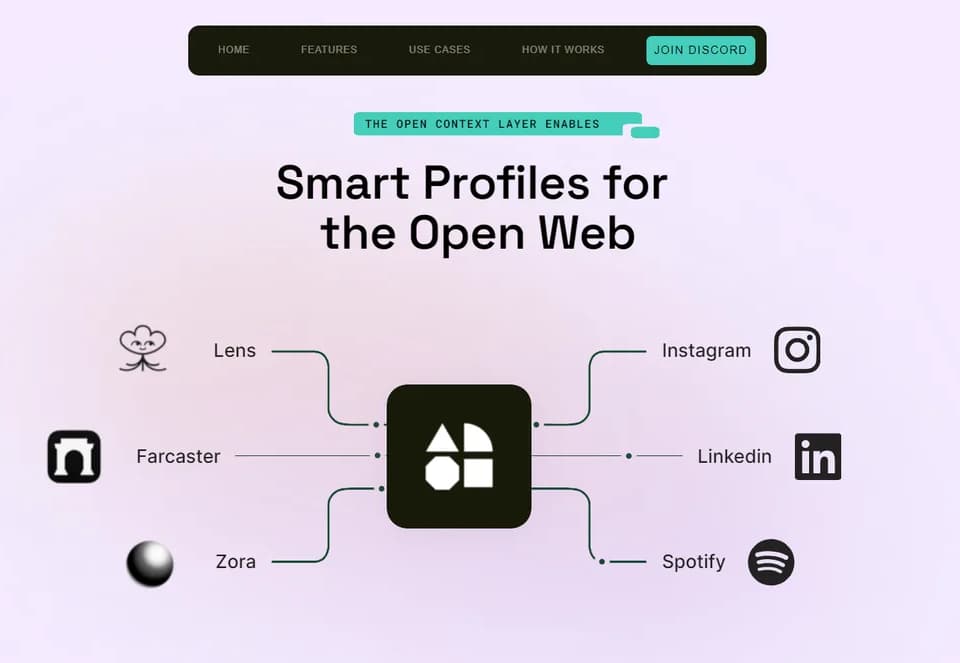
The service describes its context layer as a user-controlled store for preferences, history, and identity. It also presents Smart Profiles as privacy-preserving identity infrastructure for Web3 applications, built on Oasis Sapphire, with support for carrying context, preferences, and permissions between applications.
Notable capabilities
- Portable context for preferences, brand guidelines, writing style, team decisions, and knowledge.
- Browser extension and MCP-based access for applying stored context in supported AI workflows.
- A memory studio for organizing work, personal, and creative projects, with context switching between use cases.
- Prompt enhancement that uses stored preferences, style guidelines, and project history.
- Privacy-focused infrastructure using technologies the publisher identifies as Multi-Party Compute and Trusted Execution Environments.
Who it helps
Plurality Network is aimed at people and teams who use several AI assistants and want consistent context between them. It may also suit developers building applications or agents that need interoperable context, identity, and permission controls through open APIs and SDKs. Users with separate work, personal, or creative contexts may benefit from organizing those contexts independently.
How it fits a workflow
A user can organize relevant preferences and knowledge in the context layer, then use the browser extension or MCP server to bring that information into supported AI conversations. This is intended to reduce the need to repeat background information when moving from one assistant to another. Unibase Memory addresses a similar cross-platform memory task, with its reviewed workflow centered on capturing, searching, and sending selected context across supported AI applications.
Strengths and limits
The main stated strength is portability: context is intended to remain available independently of any one AI platform, reducing vendor lock-in and preserving continuity when users switch tools. The product also emphasizes user ownership and granular access control. The source does not specify detailed pricing, storage limits, supported operating systems, or the full scope of integrations beyond the platforms and access methods named above, so those details require verification before adoption.