
Talordata
TalorData provides a search-results API for applications, AI agents, and data workflows. Its publisher lists Google, Bing, Yandex, and DuckDuckGo access, delivering structured results rather than asking developers to maintain their own collection infrastructure.
Specify the search context
Requests can be configured by search engine, country, region, language, and device. Those controls matter when results vary by location or when an application needs to distinguish mobile results from desktop results. Store the request settings with the returned data so comparisons use the same conditions.
TalorData offers JSON output and describes HTML responses on demand. Its use cases include query planning, reranking, and citation tracing for agents. A search-result response is a discovery input; open and assess the underlying source before treating a result snippet as evidence for an article.
Separate response collection from evaluation
The publisher says it manages proxies, CAPTCHA resolution, and result collection. That can move collection work outside your application, but it does not establish that every query returns complete or correctly interpreted results. Test queries representative of your subject, locale, and desired search features.
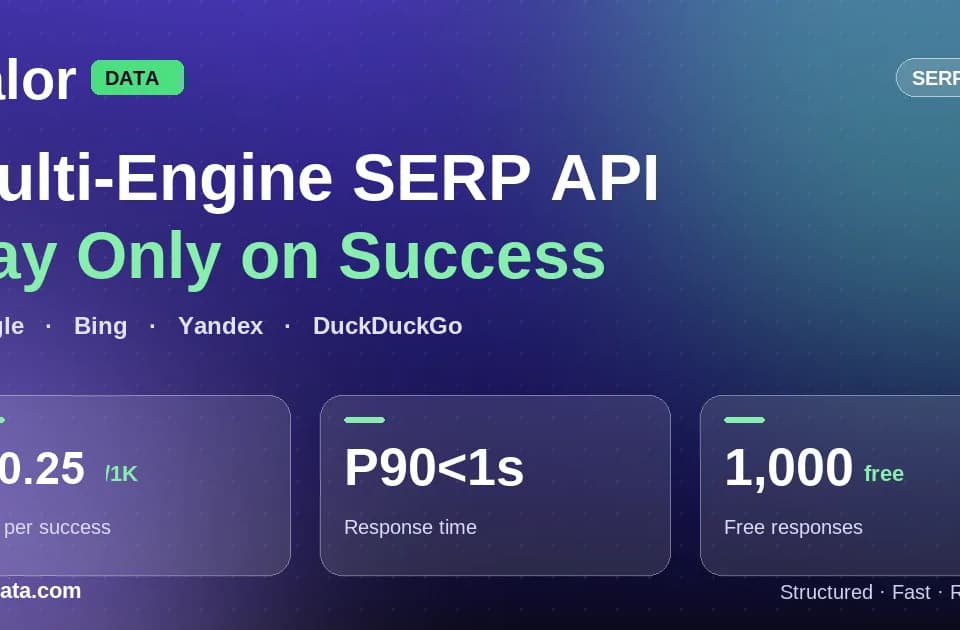
The homepage publishes its own provider comparison and a P90 latency claim below 0.8 seconds. Franklin has not reproduced that benchmark or audited its scoring method. Treat those figures as the vendor's measurements rather than independent evidence that it is the fastest or most accurate option.
Budget in successful responses
The site lists pricing starting at $0.25 per thousand responses and says only successful responses are billed. It also offers five hundred free responses after signup. Confirm the current definition of success and the applicable rate for the endpoint you plan to use.
An agent can issue several searches for one user task, so estimate query volume as well as the number of users. Inspect how empty results, retries, and reranking affect the request count. TalorData lists MCP, SDK, and API integration paths, but Franklin has not tested those connections or verified the advertised latency on production workloads.